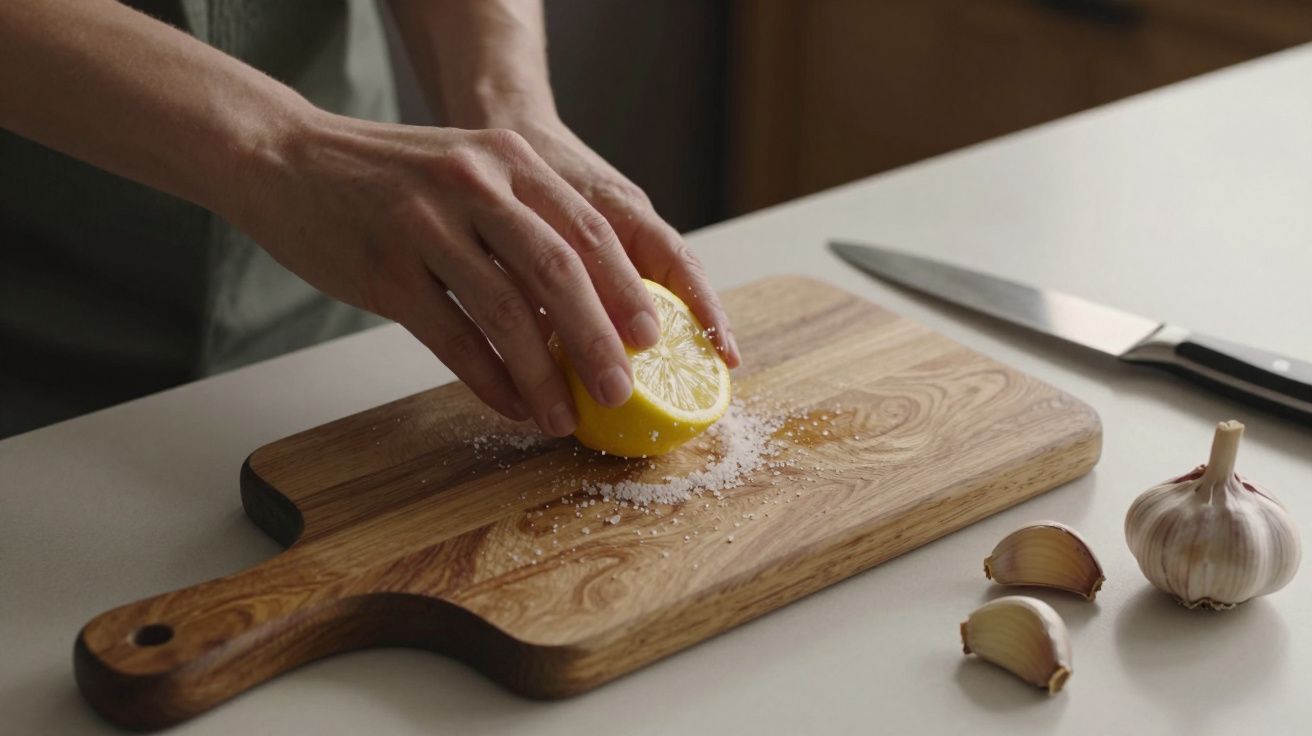
Garlic has a way of lingering. You wipe the knife, rinse the board, even give it a quick wash-up, and still-next time you slice an apple-there it is: that faint, stubborn savoury ghost trapped in the wood.
It’s not that your board is dirty in the obvious sense. Wooden chopping boards are porous by design, and that’s precisely why they pick up aromas from onions, garlic, fish and certain spices. The smell isn’t sitting on the surface; it’s clinging inside the grain where a casual rinse can’t reach.
The fix chefs reach for isn’t a “miracle” spray. It’s a two-minute scrub you can do with what’s already on your counter: salt and lemon.
Why wood holds on to garlic (and why lemon + salt shifts it)
Wood fibres act like tiny channels. When you chop garlic, you release pungent sulphur compounds that can seep into those channels, especially if the board is slightly dry or rough. Add a bit of oil from food, and the scent hangs around even longer.
The salt-and-lemon combo works because it tackles the problem from two angles. Coarse salt gives you gentle abrasion that lifts residue from the surface and the upper grain, while lemon brings acid and fresh citrus oils that help cut through odour-causing compounds. You’re not “masking” the smell; you’re loosening what’s lodged and pulling it out where you can rinse it away.
One chef put it simply: “If it smells like last night’s prep, it needs friction and acid-fast, not fancy.”
The 2-minute salt-and-lemon scrub (chef method)
Pick up your board and take a second to check it. If it’s cracked, deeply gouged, or smells musty even when dry, skip to the “when to replace” section. For a normal garlic-stinky board, do this:
Steps (quick, no faff)
- Rinse the board with warm water to remove loose bits. Don’t soak it.
- Sprinkle coarse salt over the smelliest area (about 1–2 tablespoons for an average board).
- Cut a lemon in half and use the cut side like a scrubber.
- Scrub firmly in circles and along the grain for 1–2 minutes, squeezing slightly so the juice mixes with the salt into a paste.
- Leave it for 60 seconds if the smell is strong (optional, but helpful).
- Rinse quickly with warm water, wiping clean.
- Dry immediately with a tea towel, then stand the board upright to air-dry fully.
If your board is end-grain butcher block, be a little gentler with pressure; let the salt do the work rather than grinding aggressively.
What “good” looks like afterwards
You’ll usually notice the difference as the board dries. Wet wood can still smell slightly like lemon; the real test is when it’s properly dry and at room temperature.
If you want a simple rule, use this:
| After drying | What it means | What to do |
|---|---|---|
| Neutral / faintly woody | Odours lifted | Oil lightly if the board looks dry |
| Slight garlic trace | Residue still in the grain | Repeat once more, then dry thoroughly |
| Sour, musty, or “old” smell | Possible trapped moisture or deep contamination | Consider sanding or replacing |
Common mistakes that keep the smell alive
Most odour problems aren’t from one garlicky dinner. They come from habits that leave compounds and moisture behind.
- Soaking the board in the sink. Wood swells, then traps odours as it dries unevenly.
- Using too little friction. A quick wipe with lemon juice won’t shift what’s lodged in the grain.
- Drying it flat. One side stays damp, and damp wood holds smells (and can warp).
- Skipping conditioning. A board that’s very dry is more “open” and absorbent; it drinks in aromas faster.
Let’s be honest: most of us only oil a board when we remember. But a lightly conditioned board is noticeably easier to de-odour.
A quick reset: condition the board so it resists odours
Once the board is fully dry, rub in a small amount of food-grade mineral oil (or a board cream). Work with the grain, wipe off the excess, and leave it overnight if you can. This doesn’t make the board smell-proof, but it reduces how much garlic and onion get absorbed next time.
Avoid olive oil for conditioning; it can go rancid and create its own off smell.
When to keep one board for garlic (and one for everything else)
If you cook a lot with pungent ingredients, a simple separation saves effort. Keep:
- One board for aromatics (garlic, onions, chillies, strong herbs).
- One board for “clean” prep (fruit, bread, sandwiches).
And if you prep raw meat or fish, it’s worth having a dedicated board for that too-odour removal is one thing; food safety is another.
FAQ:
- Do I have to use coarse salt? Coarse is best because it grips and scrubs without dissolving immediately. Fine salt works in a pinch, but you’ll need more pressure and it can disappear too fast.
- Can I use bottled lemon juice instead of a lemon? You can, but a fresh lemon half scrubs and releases aromatic oils from the peel that help with the “fresh” finish.
- Will this work for onion and fish smells too? Onion, yes-usually very well. Fish odours may need a second round, and the board must dry completely; dampness is often the real culprit.
- Is it safe to use bicarbonate of soda instead? Bicarb can help with odours, but it’s less effective at cutting oily residues. Salt + lemon tends to be faster for garlic-on-wood.
- My board still smells after two scrubs-what now? If it’s otherwise in good condition, lightly sand the surface, wash briefly, dry thoroughly, then oil. If it’s cracked, warped, or smells musty, replace it.



Comments
No comments yet. Be the first to comment!
Leave a Comment