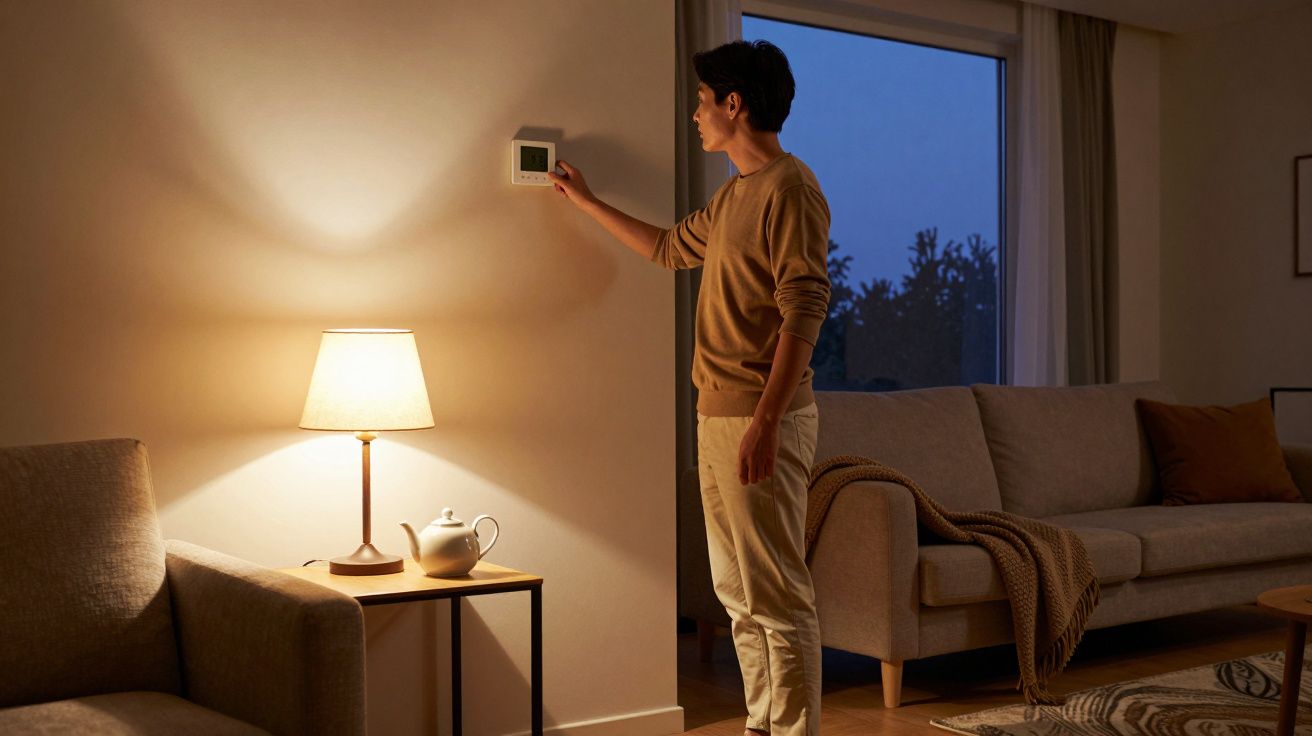
The Sunday the clocks change has a particular feel in the house. The light goes early, the kitchen feels colder sooner, and by half five the living room looks like it’s already late at night. You do the normal things: switch on lamps, put the kettle on, pull your shoulders up without noticing.
Then comes the small reflex that heating engineers see every autumn. You walk past the thermostat and nudge it up “just for tonight”, because it feels like the heating isn’t doing much. You forget about it. The next evening, you nudge it again.
Nothing’s broken. Your boiler hasn’t suddenly become inefficient. But one evening habit - triggered by darkness and routine - can quietly add around £90 over a season in many homes, according to the technicians who spend winter unpicking “why my bill jumped” calls.
The clock-change trap: you didn’t start using more heat - you started asking for it at the wrong time
Most people don’t consciously decide to heat the house for longer after the clocks change. They just start interacting with the thermostat more, because the cold part of the day now overlaps with the time they’re home, moving around, cooking, and noticing draughts.
Heating engineers describe it as a timing problem disguised as a temperature problem. The system is still on the same schedule, but your body clock and your evening routine have shifted. So you “fix” comfort by turning the temperature up, instead of fixing the schedule.
A common pattern looks like this:
- The heating is set to come on at (say) 6pm, because last week that was “evening”.
- After the clocks change, 5pm feels like 6pm, so the house feels behind.
- You turn the thermostat up to force heat now, rather than waiting.
- The house eventually warms up… but the thermostat is still set higher, so it keeps calling for heat for longer.
One technician’s blunt line: “People use the thermostat like a volume knob, but it’s closer to a target.” Turning it up doesn’t make the house heat more efficiently; it mostly makes the system run for longer until it reaches that higher target.
The evening thermostat habit that costs money: “boosting” by raising the setpoint
There are two ways people “boost” the heating:
- Using a proper boost function (smart control or programmer) that adds a timed burst.
- Raising the setpoint (the temperature on the thermostat) and forgetting to turn it back down.
Heating technicians will tell you the second one is where the money leaks out, because it changes the whole evening’s demand. A one- or two-degree increase doesn’t sound like much, but it often means:
- radiators stay hotter for longer,
- the boiler cycles more,
- the system pushes past “comfortable” into “why is it stuffy?”, and then you crack a window.
That last bit is more common than people admit. If the room overshoots because the setpoint is higher than normal, ventilation becomes the pressure valve - and you end up heating the street.
Where the “£90 over a season” comes from (a realistic back-of-the-envelope)
Every home is different, but engineers often sanity-check with simple arithmetic: extra heat demand per day × number of days.
A very typical pattern after the clocks change is either:
- an extra hour of heating in the early evening, or
- a higher setpoint that keeps heating running longer than it otherwise would.
If that behaviour adds even 6–8 kWh of gas use per day (not unusual on a chilly evening for a typical gas-heated home), and gas is roughly 6–8p/kWh, you’re looking at 40–60p/day. Over 150 days of “heating season” behaviour, that lands around £60–£90.
It won’t be exact for your house, and it can be much higher for larger or leakier properties. The point is that the cost doesn’t come from one dramatic mistake; it comes from a small nightly nudge repeated until spring.
Why it feels necessary (even when your heating is working fine)
The clock change doesn’t make your house colder. It makes you notice the cold earlier.
In the afternoon you’re often busy, moving, and benefitting from daylight and solar gain. After the clocks change, the evening “settling period” starts in darkness: you sit down, stop moving, and your body starts paying attention to drafts, floor temperature, and radiator performance.
Heating engineers say this is when people start chasing comfort with the wrong control. You’re not imagining discomfort - you’re just trying to solve it with a temperature dial instead of a timing plan.
A good rule they share: comfort complaints at 5–7pm are usually schedule-related, not boiler-related.
The fix technicians recommend: change the time, not the temperature
If you recognise the “turn it up at dusk” habit, you don’t need to live in a colder house. You just need to stop using the thermostat as a quick-fix button.
Try these swaps:
- Move the heating schedule earlier by 30–60 minutes for the first couple of weeks after the clocks change.
- Keep your usual setpoint (for many homes, somewhere around 18–20°C), and let the system reach it on time.
- If you do need a boost, use a timed boost (30–60 minutes), not a permanent higher number.
Technicians like this approach because it’s behaviour-proof. You’re less likely to fiddle if the house is already on track when you sit down.
“If you’re turning the stat up every evening, your heating is telling you the timer is wrong - not that the temperature is wrong.”
A simple evening routine that stops the “nudge up” cycle
- Pick one “normal” comfort temperature you’ll stick to.
- Set the heating to reach it before you usually sit down.
- If you’re cold, add a timed boost once - and then let it drop back automatically.
That last step matters. Forgetting is expensive; automation is cheap.
Don’t miss the other quiet culprit: heating one room, but paying to warm the hall
In a lot of UK homes, the thermostat is in a hallway or living room that behaves differently to where you actually feel cold. After the clocks change, you might be sitting still in the lounge, but the hall thermostat is being influenced by:
- an open front door,
- a draughty stairwell,
- heat rising upstairs.
So you keep turning the stat up because you are cold, but the thermostat is simply trying to warm the wrong “reference” space.
If that’s you, a technician will usually suggest one of these practical tweaks:
- Use TRVs to balance rooms (don’t throttle every radiator, but do stop overheating bedrooms).
- Keep internal doors consistent (either mostly open or mostly shut) so the thermostat “sees” a stable environment.
- If your controls allow, use a room sensor in the space you actually occupy in the evening.
Quick checks that reduce the urge to overheat (without turning your home into an icebox)
If people are constantly fiddling with the thermostat, engineers often find there’s a reason the home doesn’t feel evenly warm - and it’s not always “needs a new boiler”.
A few high-impact checks:
- Bleed radiators if you have cold spots at the top.
- Check boiler pressure is in the recommended range (commonly around 1–1.5 bar when cold, but follow your manual).
- Make sure the programmer is in AUTO, not permanently ON.
- For condensing boilers, ask about running a lower flow temperature (often improves efficiency, especially in mild weather).
- For heat pumps, avoid “panic boosts”; steady temperatures usually cost less than sharp swings.
These don’t replace professional advice, but they reduce the “it’s not working so I’ll crank it” impulse that shows up after the clocks change.
The two-minute swap list (what to do tonight)
| If you usually do this at dusk… | Try this instead… | Why it helps |
|---|---|---|
| Turn the thermostat up 1–2°C | Bring the schedule forward 30–60 mins | Same comfort, less overrun |
| Leave it high “for now” | Use a 30–60 min boost | Prevents all-evening heating |
| Heat the whole house hard | Use TRVs to prioritise evening rooms | Less wasted heat in unused spaces |
FAQ:
- Will turning the thermostat up heat my home faster? Not usually. It tells the system to keep heating until it reaches a higher target, which often means it runs longer (and overshoots), rather than warming up in a smarter way.
- Is it better to leave heating on low all day after the clocks change? It depends on your home and system. Many technicians prefer a schedule that matches occupancy, with a sensible setpoint and short boosts, rather than paying to heat an empty house.
- I only turn it up for an hour - can that really add up? Yes. If it becomes a nightly habit across a few months, small extra daily usage compounds into tens of pounds, especially in larger or less insulated homes.
- What’s the easiest “set and forget” fix? Move your evening heating start time earlier and keep the same target temperature. If you have a boost button, use that instead of raising the setpoint.
- Should I lower my boiler flow temperature? Often, yes for condensing boilers (and it’s usually essential for heat pumps), but do it carefully. If you’re unsure, ask your heating engineer to set it based on your home’s heat loss and radiator sizing.


Comments
No comments yet. Be the first to comment!
Leave a Comment