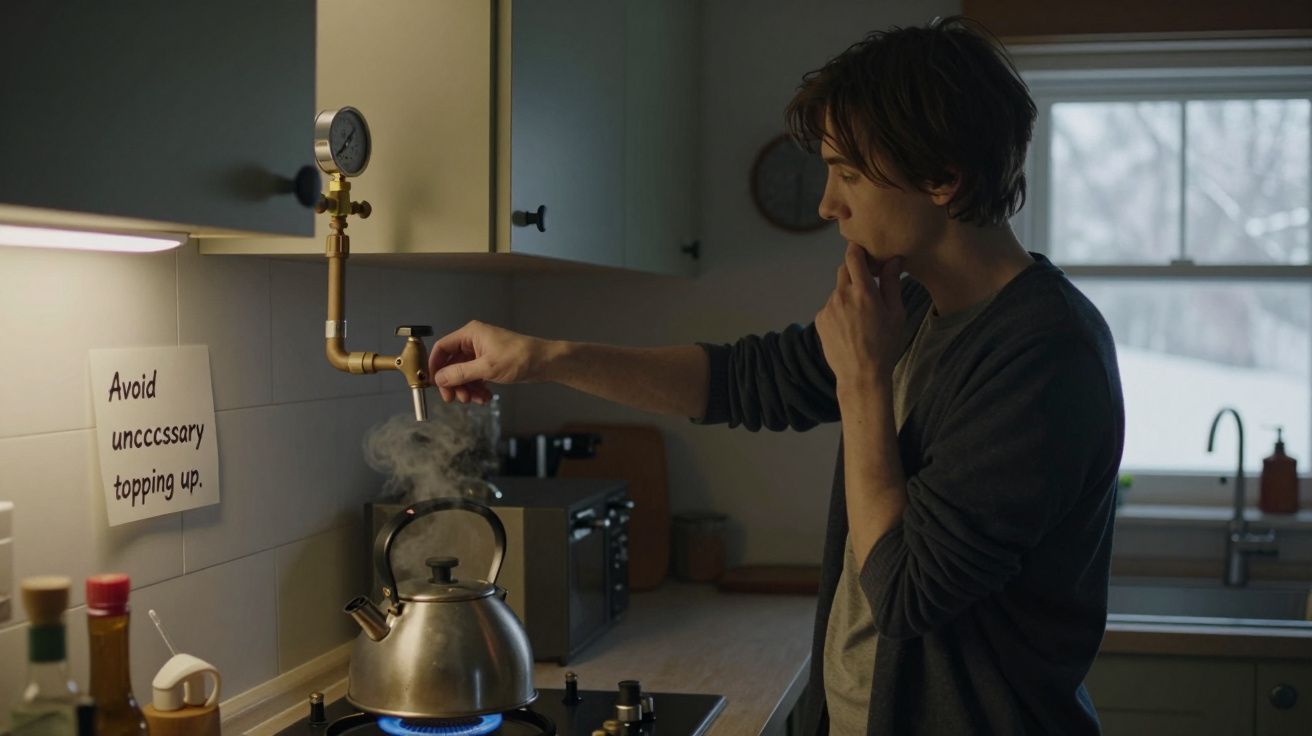
On a dark Tuesday afternoon in January, the radiators had that dull half‑warm feel that makes you wonder if the boiler is sulking. The house was quiet except for the low hum in the cupboard under the stairs. Someone put the kettle on, someone else opened the boiler flap “just to check”, and there it was: the little round gauge, needle hovering just above 1 bar.
“Better top that up before it gets cold,” came the instinctive reply. A twist of the filling loop, a faint hiss of incoming water, needle nudging towards 2. “There. Safer.”
The heating came back to life, nobody froze, and the evening moved on. The habit felt responsible, even caring - like checking the car tyres before a long drive. Why wait for trouble when you can get ahead of it?
But when a heating engineer visited a few months later for a routine service, he winced at the same gauge now steady at 2.4 bar cold. The copper pipe outside had a white streak from constant drips. Inside the boiler, components told a quieter story: lime, rust, stains around a safety valve that had been doing overtime for a year.
The boiler still “worked”. It was also ageing faster than it needed to - because of that well‑meant, casual twist of the tap.
The habit that makes your boiler work harder, not safer
Modern combi and system boilers are sealed systems. Instead of constantly drawing fresh water from the mains, they run the same treated water round and round: boiler, pipes, radiators, back again. The pressure gauge on the front is simply a window into how that closed loop is feeling.
For most homes, manufacturers want that pressure around 1.0–1.5 bar when the system is cold. As the water heats up, it expands. Pressure rises a bit, the expansion vessel quietly absorbs the swell, and the gauge might creep towards 2.0 bar while everything ticks along happily.
When people see the needle dipping slightly - maybe it was 1.3 bar last month, 1.1 this week - alarm bells ring. The internet, and sometimes well‑meaning neighbours, have taught us: low pressure = bad, high pressure = burst pipes. So we reach for the filling loop.
That’s where the problem starts.
Topping up occasionally when the pressure really has dropped too low is normal. Topping up “just in case”, every time the needle strays from where you remember it last, quietly rewrites what’s going on inside the boiler.
What really happens when you keep topping up
Every top‑up feels tiny from the outside - a few seconds of water hiss, one small movement of the gauge. Inside the system, heating engineers see the same pattern over and over.
“Frequent topping up is often the first clue I get that a boiler’s going to give its owner an expensive surprise,” one Gas Safe engineer in Manchester put it. “The water tells the story.”
Here’s why that habit matters.
1. Fresh water brings fresh oxygen - and corrosion
The water sealed in your heating system is meant to be boring. Once it’s in, any dissolved oxygen is mostly used up, corrosion inhibitor is added, and the system settles into a low‑rust, low‑drama routine.
Every time you open the filling loop, you add:
- New oxygen, which encourages internal rusting of radiators, steel components and the boiler’s heat exchanger.
- New minerals, especially in hard‑water areas, that help build limescale.
Tiny bits of rust and sludge then start circulating. They can clog narrow boiler passages, stick in pumps, or collect at the bottom of radiators. You might only notice it as a cool patch or a strange knocking sound at first. By the time it blocks something important, the fix is no longer cheap.
2. Hard water, soft metals, and expensive scale
In much of the UK, mains water is hard. Each top‑up is like shaking more chalk dust into a closed box. As that water is heated and cooled repeatedly:
- Limescale forms on internal surfaces.
- Components that need a clean, thin film of water (like plate heat exchangers in combi boilers) slowly clog.
Scale is an insulator. Your boiler has to work harder, burn more gas, and run hotter to give you the same warmth and hot water. Eventually, parts fail. The line item on the invoice - “blocked plate heat exchanger”, “burnt‑out pump” - hides a lot of invisible top‑ups from winters past.
3. High pressure forces the safety valve to keep intervening
Your boiler has a built‑in bouncer: the pressure relief valve (PRV). If pressure climbs too high (often around 3 bar), it opens and dumps water out through a small copper pipe, usually poking through an external wall.
When pressure is deliberately nudged high “to be on the safe side”, this can happen repeatedly:
- The PRV lifts slightly, lets off a bit of water, then closes.
- Each lift wears the valve seat and spring just a little.
- Over time, it can start weeping constantly - you’ll see a crusty white stain or a drip outside.
Now you have a slow leak, so the pressure slowly drops. Someone sees that drop, tops up again, the PRV lifts more… and a quiet spiral starts.
The boiler isn’t haunted. It’s stuck in a loop caused by that early instinct to over‑pressurise it in the first place.
4. Regular topping up can hide the real fault
Perhaps the most dangerous side‑effect is psychological. Seeing the gauge low and topping up feels like fixing something. For a while, it works. Radiators get hot, showers stay strong, winter passes.
But persistent pressure loss isn’t a personality trait of your boiler. It usually means:
- A leak, however small, somewhere in the system.
- An expansion vessel that’s lost its air charge.
- A PRV that was damaged in a past high‑pressure event.
By “patching” with fresh water once a week or even once a month, you can mask those faults for years - until they become big, expensive or suddenly dramatic.
Reading the gauge: when to relax, when to act
One reason topping up becomes a reflex is that few people are ever told what “normal” looks like for their specific boiler.
You’ll find exact numbers in the manual, but this rough guide holds for many sealed systems:
| Cold pressure reading | Likely situation | Sensible action |
|---|---|---|
| 0–0.5 bar | Too low, boiler may lock out | Top up once to ~1–1.5 bar. Then watch for drops. |
| 1–1.5 bar | Normal operating range | Do nothing. This is where it should be. |
| 1.5–2 bar | Still usually fine, especially if system is warm | Don’t touch the filling loop. Check again when fully cold. |
| 2–3 bar cold | Often over‑filled, or expansion issue | Do not top up. Get an engineer to investigate. |
A few practical points:
- Measure when the system is cold (off for a couple of hours). Hot water expands and will push the reading up.
- A small, slow drift over months can be normal. A drop below 1 bar several times a year is not.
- If you can’t actually remember filling the system and it’s suddenly low, that’s more suspicious than a tiny, gradual change.
The simplest rule many engineers give their customers is this:
If it’s between 1 and 1.5 bar cold, hands off the filling loop. It is not a fuel gauge - you do not need to “fill it to the top”.
When pressure keeps dropping, the system is talking to you
If you genuinely need to top up more than once or twice a year, that is your early warning siren. Not a sign to keep topping up. A sign to ask why.
Common culprits include:
- Microscopic leaks at radiator valves or under floorboards.
- A leaking PRV, often after someone ran the system at very high pressure.
- A failing expansion vessel - the rubber diaphragm inside has lost its air cushion, so the system can’t absorb expansion properly.
- Internal leaks in the boiler itself.
Left alone, these don’t cure themselves. They quietly:
- Pump more oxygen and minerals into the system via your top‑ups.
- Strain the boiler each time it heats from very low to high pressure.
- Increase the risk of a dramatic failure at the coldest, least convenient moment.
Calling a Gas Safe registered engineer when you notice recurring pressure loss can feel like overkill compared to “just turning the tap”. Yet it’s often the difference between a small repair and a whole‑unit replacement a few winters earlier than necessary.
Healthier boiler habits that actually protect it
You don’t need to become a heating technician to look after a sealed system. A few simple rituals do more for your boiler than any number of nervous top‑ups.
- Check the gauge once a month, not every day. Look when the system is cold. Note the reading, then forget about it until next time unless you see obvious changes.
- Only top up when it’s genuinely low. If the pressure is below what your manual specifies (often ~1 bar cold) and the boiler has locked out, top up slowly to the recommended level. Close the filling loop firmly afterwards.
- Never leave the filling loop open. Some people accidentally leave it slightly cracked; the system creeps up to 3 bar as it heats, then the PRV continually dumps water. Always double‑check the valves are fully shut.
- Take photos if something changes. A quick snap of the gauge at different times, or of a new drip mark below a radiator, gives an engineer clues without guesswork.
- Ask for the expansion vessel to be checked at service. A reputable engineer will test and recharge it if needed. A healthy vessel keeps pressure swings gentle and reduces the need to top up.
- Watch the copper pipe outside. If the little overflow pipe is staining the wall or dripping, don’t ignore it. That’s your PRV trying to get your attention.
The goal isn’t a perfectly flat gauge. It’s a system that lives within its comfort zone without you constantly intervening.
A small change that buys you years of quiet heat
Most people only think about boiler pressure when something goes wrong: no hot water, cold radiators, an ominous red warning light. In between, the gauge sits there like a clock you’ve stopped checking.
The temptation to “get ahead of the problem” by topping up “just in case” is human. It looks caring, cautious, even sensible. It also quietly undermines the very reliability you’re trying to protect.
Leave a stable 1–1.5 bar alone. Treat repeated drops as a message to investigate, not a chore to override. Let the expansion vessel and safety valves do their designed jobs, instead of pulling them into your anxiety loop.
In practice, that often means fewer twists of a tap, not more. A phone call to an engineer a year earlier than you might have planned. And a boiler that hums away in the background, season after season, without the drama - or the hidden damage - that constant topping up can bring.
FAQ:
- How often is it normal to top up my boiler pressure?
In a healthy, sealed system, many engineers say once a year or less. Needing to top up every few months, or worse every few weeks, usually points to a fault that should be investigated.- What should I do if my boiler keeps losing pressure but I can’t see any leaks?
Hidden leaks under floors, a failing expansion vessel or a weeping pressure relief valve are all possibilities. Keep a note of how fast it drops and ask a Gas Safe registered engineer to diagnose the cause rather than repeatedly topping up.- Is it dangerous to run with low pressure?
The boiler will normally shut itself down if the pressure falls too low to operate safely. You won’t usually damage the boiler by briefly running at the lower end of the scale, but you may lose heating or hot water until the pressure is restored.- Is there ever a good reason to raise the pressure above 1.5 bar cold?
Only follow what your specific boiler manual or engineer advises. For most domestic systems, pushing it higher “just to be safe” offers no benefit and increases stress on components.- Can I safely top up the pressure myself?
Yes, if you follow the manufacturer’s instructions: system off and cool, open the filling loop slowly, stop at the recommended pressure, and close the valves firmly. The key is to treat this as an occasional corrective step, not a routine weekly task.





Comments
No comments yet. Be the first to comment!
Leave a Comment