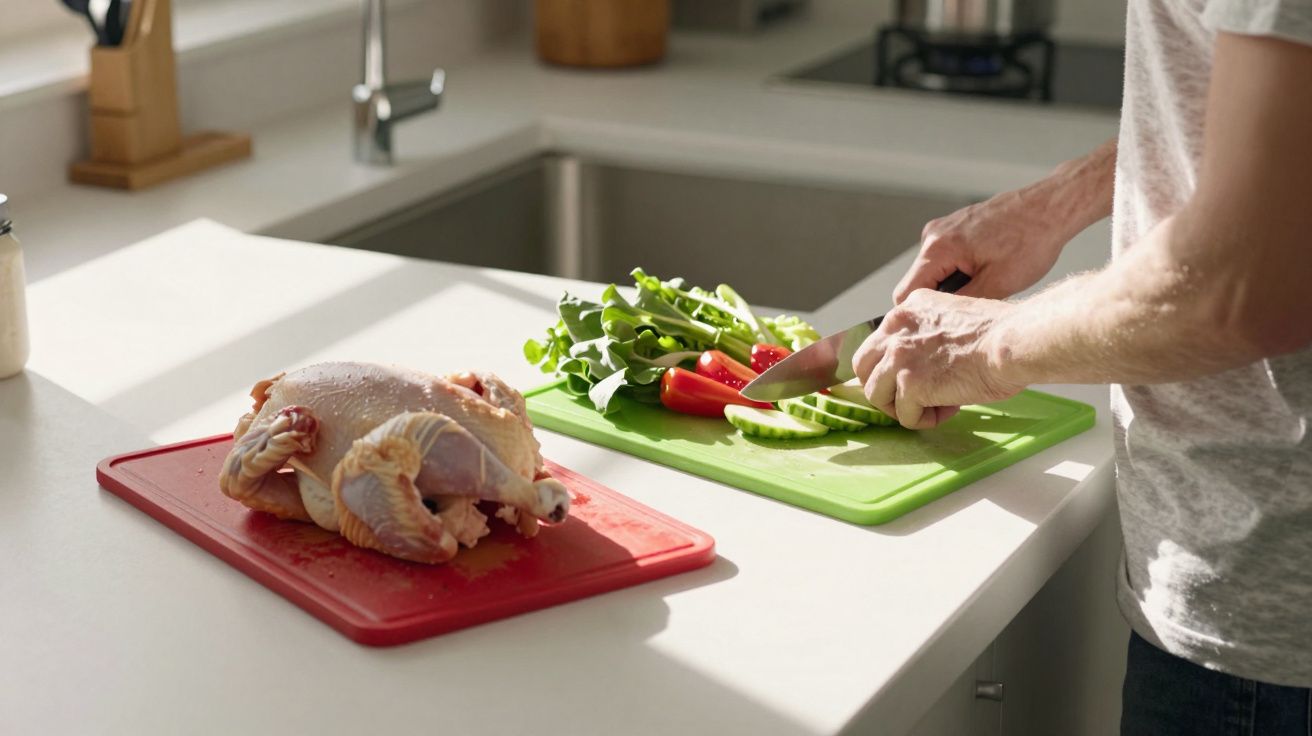
A food inspector walks into a small café kitchen. No fancy kit, no gleaming gadgets. Just a cramped counter, a sink, and two battered plastic chopping boards: one stained a permanent pink, the other a tired green. Service is busy, knives are moving fast. Raw chicken lands on the pink board, salad on the green. No drama, no lecture. The inspector ticks a box on the form and moves on.
Now picture the average home. One wooden board in the middle of the worktop. You dice raw chicken for a stir-fry, give the board a quick wipe with the same sponge you used on the hob, then slice cucumbers for a side salad on that “clean” surface. No one falls ill that evening, so the habit feels harmless. The trouble is, food poisoning doesn’t always announce itself the same day.
In professional kitchens, the “two chopping boards” rule is so basic it’s almost boring. In private homes, it’s still treated as optional, something for neat freaks or TV chefs. Inspectors quietly wish it wasn’t. Because from their point of view, a separate board for raw meat and a separate board for ready-to-eat food is one of the simplest ways to stop a pleasant dinner turning into a long night in the bathroom. Or worse.
Why your single chopping board is riskier than it looks
Raw meat and poultry are often loaded with bacteria such as Campylobacter, Salmonella and E. coli. You cannot see, smell, or taste them. A board that “looks clean” after a wipe with a sponge can still carry enough bacteria to make someone ill, especially children, pregnant women, older people, and anyone with a weaker immune system.
The classic home-kitchen chain reaction looks like this: raw chicken on the board, raw juices spread across the surface, then the same board is used for bread, salad, cooked meat or fruit. The heat of cooking would have killed the bacteria on the chicken. But the lettuce and the sliced baguette never see a frying pan, so anything that lands on them goes directly into your mouth.
Sponges and cloths often make things worse. They soak up raw meat juices, then smear them around the sink, the board, the tap handles. Let’s be honest: nobody disinfects their sponge between each task. We’re all busy, hungry, distracted. That’s exactly why the two-board rule helps so much. It builds a margin of safety into the mess of everyday cooking.
The simple two-board rule inspectors swear by
The rule is this: at minimum, keep one board only for raw meat, poultry and fish, and one board only for ready-to-eat food. They should never swap roles.
In practice, that means:
- Raw board: raw chicken, other poultry, raw beef, pork, lamb, raw mince, raw sausages, raw fish and shellfish.
- Ready-to-eat board: salad leaves, tomatoes, cucumbers, fruit, bread, cheese, cooked meat, cold leftovers, anything that will not be cooked again.
If you’re chopping vegetables that will go straight into a pan (onions for a stew, carrots for roasting), they are safer than salad, but inspectors still prefer they don’t share with raw meat. A third “veg” board is ideal if you cook a lot. The absolute minimum, though, is splitting raw animal foods from anything eaten cold.
A simple colour code stops thinking getting in the way:
- Red / dark board = raw meat, poultry, fish only.
- Green / light board = ready-to-eat only.
Tape a tiny label on the side if you share a kitchen or know you’ll forget under pressure.
At a glance: what goes where
| Board type | Use it for |
|---|---|
| “Raw” board | Raw meat, poultry, fish, shellfish |
| “Ready-to-eat” board | Salads, fruit, bread, cheese, cooked foods |
If in doubt, ask yourself: “Will this food be cooked after it touches the board?”
If the answer is no, it should never touch the raw board.
How to clean boards so the rule actually works
Two boards only help if they’re properly cleaned. Rinsing under the tap until the stains fade is not enough.
For each use:
- Scrape off food debris into the bin.
- Wash in hot, soapy water, using a brush or clean cloth.
- Rinse well and leave to air-dry standing up, not flat in a damp pile.
Plastic boards that are dishwasher-safe can go through a hot cycle; that’s one reason professionals like them. Wooden boards are fine for home use, but they must dry fully between uses and be replaced when they are deeply scored. Cuts and grooves trap bacteria where washing can’t easily reach.
Three small but important habits inspectors look for:
- Separate cloths for wiping boards and wiping the floor or hob.
- No quick reuse: don’t slice cooked meat on a board that has just had raw meat, even if it has been rinsed but not fully washed.
- Regular replacement: if a board smells even after washing, or looks furry, split or heavily scored, it’s time to bin it.
A good rule of thumb: if you’d be embarrassed to serve food on it as a platter, it’s too tired to chop safely on.
Making the rule easy at home (even in a tiny kitchen)
Many people resist extra boards because they fear clutter. Inspectors know that if a system is awkward, nobody will keep it up for long. The aim is not perfection. It’s a small, reliable upgrade.
Simple tweaks that help:
- Choose slim, light boards that stack neatly; two can take less room than one heavy butcher’s block.
- Store boards upright at the back of the worktop or in a narrow cupboard so they dry and stay visible.
- Match knives with boards if you can: for example, the knife you usually use for raw meat lives next to the raw board.
- Agree the rule out loud with anyone you live with: “Red is raw. Green is for salads and ready stuff. No swapping.”
Let’s be honest: nobody really notes every single time a board is “technically cross-contaminated”. Life is too short. The point of the two-board rule is to catch most of the risky moments automatically, without needing a lecture in microbiology before every sandwich.
Beyond boards: quick checks inspectors mentally do
Food inspectors don’t just glance at your chopping boards. In their head, they are running a rapid little film of what might happen in your kitchen at 6pm on a Tuesday.
A 30-second self-check before you cook makes a big difference:
- Is there a clean cloth or paper towel ready, or will you end up using the same one for everything?
- Is the raw meat board and knife ready, instead of juggling mince and salad on the same surface?
- Is there a clear space for cooked food to land, away from raw juices?
These small pauses are the home-cook version of a professional kitchen’s “mise en place”. They stop the worst shortcuts before they start.
Thinking beyond tonight’s dinner
Food poisoning often gets dismissed as “a bit of a dodgy tummy”. Yet serious cases send people to A&E every week, and vulnerable family members can suffer long-term effects. Many of those cases start with a perfectly ordinary meal, cooked with care, in a perfectly normal kitchen.
The two-board rule is not about turning your home into a restaurant. It’s about matching one of the simplest professional habits to the reality of family life. Two cheap boards, one clear rule, and a bit less anxiety each time you put raw chicken on the counter.
In the end, every slice of bread that never touches raw meat juice is one less chance for invisible bacteria to hitch a ride to your plate.
FAQ:
- Do I really need two boards if I live alone? Yes, the bacteria don’t care how many people you cook for. The same risks apply, and two boards cost very little compared with a bout of food poisoning.
- Can I just flip the same board over for raw and ready-to-eat food? It’s better than nothing, but it’s easy to forget which side is which, and juices can run around the edges. Two clearly separate boards are safer and simpler.
- Are wooden or plastic boards safer? Both can be safe if cleaned properly. Plastic often copes better with dishwashers; wood must be dried thoroughly and replaced when heavily scored. The key is separation and cleaning, not the material alone.
- If I wash the board well between tasks, do I still need two? Washing reduces risk, but in busy real life people cut corners. Having a dedicated raw board and a dedicated ready-to-eat board removes the danger of “I’ll just…” moments when you are tired or rushed.
- What about colour-coded professional sets (red, green, blue, etc.)? They’re useful but not essential at home. If you only adopt one idea, make it this: one board for raw meat and fish, one board for everything ready to eat. That change alone does most of the safety work.




Comments
No comments yet. Be the first to comment!
Leave a Comment