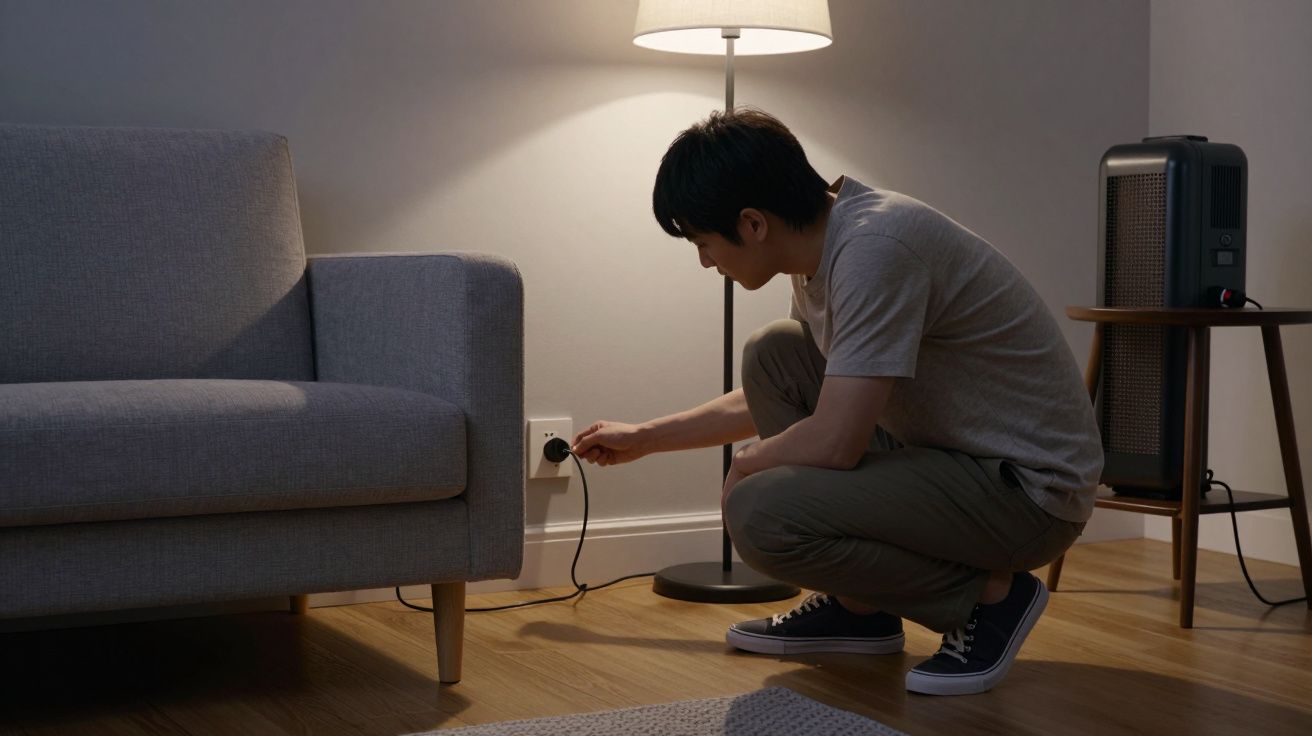
The plug socket has been a workhorse all winter. Phone chargers, fairy lights, laptop, electric throw, that little fan heater you drag over to the sofa on cold nights – all fed through the same chunky white adapter.
One evening you crouch down to unplug something and notice it: the block feels warm. Not hot, not alarming, just… warmer than you’d expect a lump of plastic to be. You frown, wiggle the plugs, and tell yourself it’s fine. If it were really dangerous, surely it would trip a switch or smell of burning.
A week later an electrician comes to fit a new light. He glances behind the TV unit, then at the adapter by the sofa, and his face changes in that quiet, professional way.
“That one,” he says, pointing to the socket with the heater plugged in, “should never have a multi-way on it. Not ever.”
You look at the nest of wires and feel a small, cold twist in your stomach. Because if there’s one socket in the living room you’ve absolutely been overloading, it’s probably that one.
The quiet fire risk hiding behind the sofa
Electrical fires in homes don’t usually start with sparks flying dramatically out of the wall. More often, they begin with something unremarkable getting slowly, steadily too hot: a plug, an adapter, a cable hidden behind a piece of furniture.
In the UK, a standard socket is designed for up to 13 amps – roughly 3,000 watts. A multi‑way adapter doesn’t magically give you more capacity. It just gives you more ways to spend the same budget.
A typical portable heater or electric fire can swallow nearly that entire allowance on its own. Add in a lamp and a phone charger on a multi‑way block, and on paper you may still be “within the limit”. In real life – with cheap adapters, coiled leads, dust, and poor ventilation – the safety margins shrink fast.
Electricians and fire investigators see the pattern again and again. The living room feels cosy, everyone relaxes, and the one overloaded socket quietly bakes away behind the sofa.
Why living rooms are especially sneaky
Kitchens look dangerous, so we treat them that way. We know the kettle, microwave and toaster are “big” appliances. The living room, by contrast, feels harmless: it’s just TVs and fairy lights, right?
Not quite. Modern living rooms often cram a surprising number of hungry devices into a small corner:
- TV, soundbar, games console, broadband router
- Electric fire or portable heater
- Floor and table lamps
- Phone, tablet and laptop chargers
- Air purifiers, fans, electric throws or heated cushions
- Seasonal extras: Christmas tree lights, decorations, extra lamps
Individually, many of these use very little power. Together – especially when you add a heater – they quietly push a single socket far closer to its safe limit than you’d expect.
The problem is less “one big mistake” and more a lot of small, understandable decisions that add up: one extra adapter, one more charger, one more winter where a block sits half-hidden, never really checked.
The one socket that should never host a multi‑way adapter
Ask working electricians which living‑room socket worries them most, and you’ll hear the same answer: the one that feeds any high‑powered heater.
If a portable heater, electric fire or plug‑in radiator uses that socket, it should have the outlet to itself. No cube adapter. No four‑way block. No tower with USB ports and switches that looks clever on the box.
Just heater, straight into wall.
The reason is brutally simple. Many portable heaters draw 2,000–3,000 watts on their own. That’s already close to the 13‑amp maximum a UK socket and plug are meant to handle. Put that load through a multi‑way block – especially a cheap, unswitched one – and every tiny weakness matters: thin internal wiring, tired contacts, loose pins, dust.
Now add a lamp, a console and a charger for “only a bit extra”. On a cold Sunday, you turn everything on, settle under a blanket and maybe leave the room for a while. The plug is out of sight, the adapter can’t lose heat easily, and if it starts to overheat you probably won’t notice until the plastic has already softened or scorched.
So, in plain terms:
Any socket that powers a portable heater or electric fire should not host a multi‑way adapter. The heater belongs directly in the wall, on its own.
You can safely use quality extension leads for low‑power items elsewhere in the room – more on that in a moment. But the “heater socket” needs to stay single.
What can safely share an adapter – and what really shouldn’t
The good news is you don’t have to panic about every extension lead in your living room. The trick is knowing which kinds of devices are “lightweight” and which are heavy hitters.
A rough guide:
| Appliance type | Typical power use | Adapter rule |
|---|---|---|
| Phone / tablet chargers | 5–20 W each | Fine on a good‑quality extension lead |
| Router, TV, games console | 20–300 W each | Usually fine together on one block* |
| Lamps, fairy lights | 5–40 W each (LED) | Fine on one block |
| Portable heaters, electric fires | 1,500–3,000 W | Wall only, no multi‑way adapter |
| Tumble dryers, washing machines | 2,000–3,000+ W | Not for living rooms – but same rule: wall only |
*As long as the total stays under 13 amps / 3,000 W and you’re not daisy‑chaining adapters.
The pattern is simple: things that make heat tend to be the most power‑hungry. Heaters, irons, kettles, toasters – none of them should go through a multi‑way block.
Your screen, router and chargers, by contrast, use far less. They’re usually fine sharing a decent extension lead that’s rated for 13 amps, has a fuse, and ideally includes overload protection.
How to make your living room safer in 10 minutes
You don’t need to learn wiring diagrams or memorise wattages. A short, practical “audit” of your living room can remove most of the risk.
Find the heater socket
Locate whichever socket your portable heater or electric fire uses most often. If there’s anything plugged into the same adapter or double socket, change it so the heater has one socket to itself, directly in the wall.Retire cube adapters
Those chunky plug‑in cubes that turn one outlet into three or four? Electricians hate them. They tug at the wall socket, overheat easily and make it hard to see what’s really connected. Replace them with a short, fused extension lead with a cable.Stop daisy‑chaining
Never plug one extension lead into another to “make it reach”. If the cable won’t reach another area, you need a longer, single lead – or, long‑term, an extra wall socket fitted.Move the low‑power stuff
Group small items like phone chargers, the router and TV kit on one properly‑rated extension strip, and keep heavy heat‑producing items on their own sockets where possible.Feel for warmth, once in a while
With everything switched on, touch the plugs and the body of the adapter. Slight warmth is normal; anything hot or too warm to keep your hand on is a warning sign. Switch off, unplug, and replace the adapter.Keep leads uncoiled and uncovered
Coiled cable under a rug or squashed behind furniture can’t shed heat. Lay leads out flat where possible and avoid running them under thick carpets or heavy furniture.
Soyons honnêtes : personne ne fait vraiment ce tour complet chaque week‑end. But doing it once when you bring the heater out for winter – and again when you put it away – is enough to catch most problems before they become dangerous.
A small, boring habit that quietly prevents big dramas
On the surface, giving one plug socket “special status” in your living room doesn’t sound like much. There’s no satisfying gadget, no app, no dramatic before‑and‑after photo. Just a mental note: the heater socket always stays single.
Yet that tiny rule nudges a lot of other behaviour into a safer place. It makes you more likely to use proper extension leads for low‑power items, less likely to stack adapters “just for now”, and more inclined to keep that high‑load plug visible rather than buried behind a plant.
Electricians tend to see households at their worst – after the scorch mark, the tripped breaker, the near miss. When they all keep repeating the same sentence about that one living‑room socket, it’s worth listening.
The living room should be the place you unwind, not the place you unknowingly stack risks. Give the heater its own socket, treat adapters as helpers for light‑duty kit only, and check occasionally for warmth and wear. Your future self, curled up on the sofa on a cold night, won’t notice anything dramatic.
And that’s exactly the point.
FAQ:
- Is it ever safe to plug a heater into an extension lead?
Ideally, no. Heaters should go directly into a wall socket. If you absolutely must use an extension, it needs to be a heavy‑duty, fully unwound, fused 13‑amp lead from a reputable brand, with nothing else plugged in – but most electricians would still tell you to avoid it.- Can I use a multi‑way adapter for my TV, console and router together?
Yes, in most cases. Those devices are relatively low‑power. Use a good‑quality, fused extension strip (not a cube), keep the total load under 13 amps and avoid daisy‑chaining multiple adapters.- How do I know if my adapter is overloaded?
Warning signs include the plug, adapter or cable feeling hot, discolouration or scorch marks, a plastic smell, or fuses and breakers tripping repeatedly. If in doubt, switch off and replace the adapter with a better‑rated one – or reduce what’s plugged into it.- Are USB extension towers and “smart” strips safer?
The extra features don’t change the basic limit: 13 amps per socket. Choose products with clear ratings, BS (British Standard) markings and built‑in overload protection, and still keep heaters and other high‑load items off them.- Should I get more wall sockets fitted instead?
If you rely on multiple adapters and trailing leads all year round, a qualified electrician adding a few extra outlets is usually safer and tidier in the long run than endlessly upgrading extension blocks.



Comments
No comments yet. Be the first to comment!
Leave a Comment