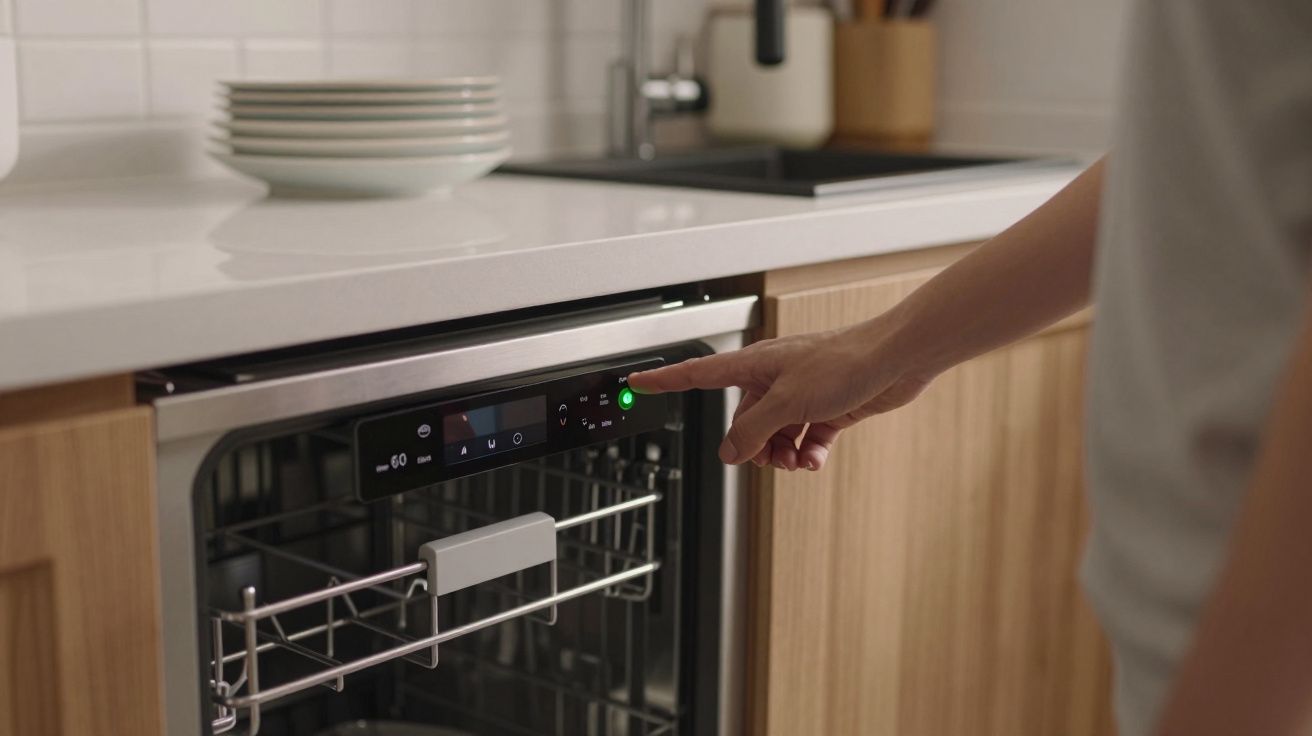
Your dishwasher sits under the counter, humming away like always. Lights blink, water whooshes, plates emerge vaguely cleaner than before. Somewhere along the control panel is a small button with a leaf, or the word “Eco”, that you probably skipped past the day you moved in.
You went for “Quick”, “30 min”, or “Intensive” instead. You wanted things done fast. You pressed the big familiar symbol, not the modest green one. Months later, your energy direct debit crept up again, and you assumed it was just “everything going up”.
That little button might be quietly costing you up to £60 a year.
Why the eco cycle is slower but cheaper
On modern dishwashers, the eco programme is usually the most energy‑efficient option, even if it doesn’t feel that way. It runs longer, uses lower temperatures, and relies on soaking rather than brute heat.
The logic is simple: heating water is what eats electricity. If the machine spends more time gently washing at 45–50°C instead of blasting at 60–70°C, it pulls far fewer kilowatt hours per cycle.
Manufacturers have to test energy labels using the eco mode, not the flashy “quick” wash. That’s the setting the efficiency sticker is based on. If you’re rarely using it, you’re not getting anything like the savings the leaflet promised.
Across a typical year:
- If you run the dishwasher 4–7 times a week
- And you mostly use standard or intensive cycles
- Switching to eco on everyday loads can trim £30–£60* off your electricity use, depending on your tariff and machine
*Figures based on typical differences of 0.3–0.7 kWh per wash and unit prices around today’s price cap. Older or less efficient machines can vary either way.
How much more does “non‑eco” really cost?
Numbers help this land. These are ballpark figures from common energy-label data and independent tests:
| Programme type | Typical energy per wash | Approx. annual cost (5×/week) |
|---|---|---|
| Eco / “ECO 50°” | 0.6–0.9 kWh | ~£45–£70 |
| Standard / “Auto” | 0.9–1.2 kWh | ~£70–£95 |
| Intensive / “Hygiene 70°” | 1.2–1.6 kWh | ~£95–£125 |
Assumes 26–30p per kWh and 260 washes per year. Your exact model and settings will shift the numbers, but the pattern stays the same: the further you go from eco, the more each run costs.
Two points most people miss:
- “Quick” rarely means cheap. Fast washes often crank up the temperature to compensate for less time on the clock.
- The energy display (if your machine has one) can be misleading if you only glance at minutes, not kilowatt hours.
The annoying truth: if you’re in no rush, the slow, boring eco choice nearly always wins.
What the eco button actually does
It’s not magic. It’s just your dishwasher using its brains instead of its biceps.
Most eco cycles:
- Lower the wash temperature so the heating element works less
- Extend the wash time to allow soaking and efficient spraying
- Optimise spray patterns and pump speed for lower power
- Use less water, which indirectly means less water to heat
That combination trims energy use without forcing you back to hand‑washing.
The trade-off is time. Instead of 30–60 minutes, you may see 2.5–4 hours on the display. In a world obsessed with “express” and “turbo”, that looks wrong. But the machine is working more slowly, not more hard.
Provided you’re not opening the door halfway or forcing it to re‑wash, the longer cycle doesn’t translate into a higher bill. It does the opposite.
When eco makes sense – and when it doesn’t
You don’t have to be purist about it. Think of eco as your default, with a few sensible exceptions.
Use eco when:
- Dishes are normally soiled – everyday plates, mugs, cutlery
- You can run it overnight or while you’re out
- You’re running almost full loads (ideally 80–100% full, without blocking the spray arms)
- You don’t need spotless pans in 45 minutes flat
Switch to a hotter or different cycle when:
- You’re dealing with very greasy roasting tins or baked‑on lasagne
- You need extra hygiene (e.g. after raw chicken mishaps, or for baby bottles if your manual recommends higher temperatures)
- You’re running a machine‑cleaning cycle with a cleaner or vinegar to clear limescale and grease
If in doubt, check the manual (or the PDF version online). Many list estimated energy and water for each programme. The eco line is often a quiet standout.
How to set yourself up to actually use it
Knowing eco is cheaper is one thing. Remembering to press it when you’ve got pasta welded to a plate is another.
A few simple tweaks help:
Make eco the default
If your dishwasher remembers the last programme used, consciously choose eco for a week. It will then come up automatically.Time it with your routine
Load after dinner, run eco as you go to bed, empty in the morning. The long run time stops mattering once it’s in the background of your day.Load smartly, skip the pre‑rinse
Scrape food into the bin, don’t half‑wash. Eco relies on sensors and chemistry; if everything goes in almost clean, you’ve just wasted hot water at the tap instead.Use the right detergent and salt
All‑in‑one tablets and proper dishwasher salt help eco cycles perform well. Don’t pour normal table salt into the salt compartment – it’s not the same and can clog systems.
Over a few weeks, the unfamiliar “ECO 50°” button goes from novelty to muscle memory.
Extra ways to squeeze the bill lower
The programme you pick is only one lever. Small, boring habits add up alongside that £60.
Consider:
- Only running full loads – two half‑loads almost double your energy and water use
- Turning off extra‑dry or “TurboDry” options unless you truly need them
- Letting dishes air‑dry by popping the door open slightly at the end of the cycle
- Checking the filter monthly so the pump and spray arms don’t waste energy on clogs
- Dropping the water temperature on your boiler if the dishwasher is plumbed to hot and your manual approves it
None of this feels dramatic. That’s the point. You don’t have to live by candlelight to cut a few quiet pounds from the direct debit.
What this overlooked button says about home energy
The eco button is a tiny symbol on a crowded panel, easy to ignore in the rush of making dinner and clearing up. It’s also a neat snapshot of how many of us deal with energy prices: we worry, we complain, and then we keep pressing the old familiar options.
Your dishwasher is not the biggest load in the house – heating and hot water usually win that contest. Yet it’s a test case for a wider shift: using what you already own in the way it was designed to be efficient, not just convenient.
You don’t need a smart meter lecture or a new gadget. You need to notice one small button, press it more often, and let a long, patient wash work in the background while you get on with your evening.
Key points at a glance
| Point | Detail |
|---|---|
| Eco cycles heat less, wash longer | Lower temperatures mean less electricity per load, even though the timer looks scary |
| Skipping eco can add up | Regular use of standard/intensive programmes can cost up to ~£60 more per year |
| Use eco as default | Switch to hotter cycles only for very greasy or hygiene‑critical loads |
FAQ:
- Does eco use more water because it runs longer?
Not usually. Most eco programmes are designed to use less water overall, then heat that smaller volume efficiently. The longer time is about soaking, not about endless refilling.- Will dishes come out less clean on eco?
For normal, everyday loads, a modern dishwasher’s eco cycle should clean just as well, as long as you load it properly and scrape off heavy leftovers. For burnt‑on or very greasy items, a hotter cycle can still be worth it.- Is it better to hand‑wash than run the dishwasher on eco?
In many homes, a full dishwasher on eco uses less water and energy than washing the same load by hand in hot, running water. If you tend to leave the tap on, the machine often wins.- What if my dishwasher doesn’t have an eco button?
Older or very basic models may not label it that way. Look for a “50°”, “Economy”, or “Energy‑saving” wash in the manual and use the lowest‑temperature standard programme for everyday loads.





Comments
No comments yet. Be the first to comment!
Leave a Comment