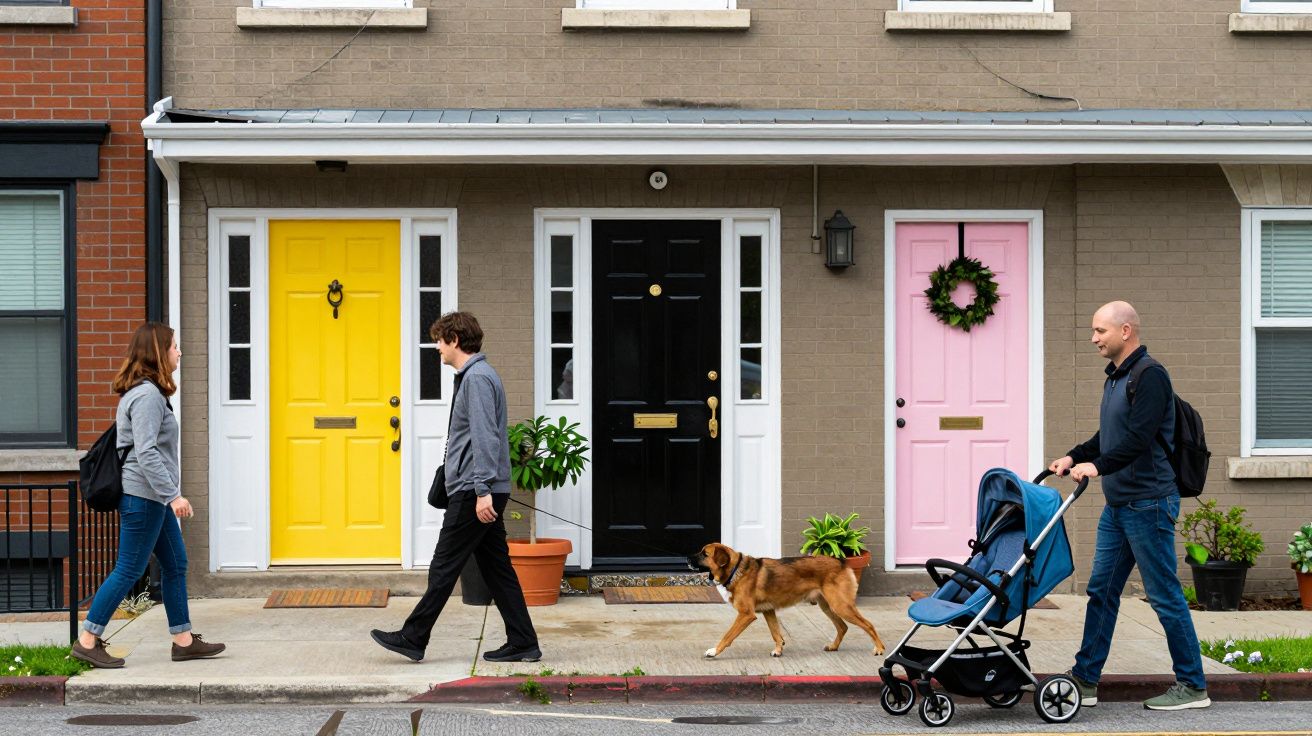
You stand at the end of your street and your eye does what it always does: scans the row of doors like a line of faces. The glossy black with brass knocker that looks slightly superior. The sunflower yellow that seems to grin even in January. The peeling brown one that makes you wonder if the boiler works.
Now imagine everyone else is doing the same thing to yours.
Choosing paint suddenly feels less like DIY and more like branding. You’re not just deciding between “Sage Whisper” and “Urban Night”; you’re deciding what story your front step tells to the people who walk past with dogs, parcels and prams.
Psychologists will tell you you’re not imagining it. The colour you choose really can nudge how neighbours see you – but not for the mystical reasons paint charts sometimes promise.
Why a strip of colour feels like a character test
We are wired to make snap judgements. Give the human brain half a postcode and a front elevation and it will happily invent a personality to go with it. Social psychologists call this “thin-slicing”: forming views about people from tiny slices of information.
A front door is one of those slices. It is a bold, simple block in your field of vision, framed by bricks and letterboxes and doorbells. You don’t need to be nosey; your brain is already having opinions before you’ve reached the wheelie bins.
Dr Hannah Courtney, an environmental psychologist, explains it brutally:
“Your front door sits in the same mental category as clothes, hairstyle and shoes. It’s part of the ‘package’ people use to guess who lives inside – how tidy, how friendly, how much like ‘us’.”
We’re not usually aware we’re doing this. You don’t think “blue door, therefore conscientious owner”. You just have a faint sense that one house feels calmer, more cared for, or somehow “nice”, and that impression quietly colours your expectations of the people inside.
What the research actually says about colour and first impressions
There isn’t a single grand study where scientists painted every door on an estate and measured neighbourly vibes for a decade. But there are several strands of research that, together, explain why your choice matters.
- Studies on shopfronts and restaurants show that exterior colours shift how welcoming, expensive or trustworthy a place seems.
- “Curb appeal” experiments find that people rate identical houses as more desirable, friendly or safe when the entrance looks brighter and more maintained.
- Colour psychology research repeatedly links certain hues with emotional impressions – blues with calm and reliability, reds with energy and dominance, greens with nature and balance.
When researchers show people quick images of homes with digitally altered door colours, the pattern is consistent: participants ascribe different traits to the owner based solely on that coloured rectangle. More organised. More creative. More stuck-up. Less approachable.
What’s going on is not magic in the paint. It’s a mix of:
- Associations (red = danger, passion; green = gardens, eco).
- Cultural norms (black in a Georgian terrace feels “classic”; the same black on a neglected block of flats can read as “gloomy”).
- Halo effect (if one bit of the entrance looks stylish, we assume the people and the rest of the house are too).
The key point: colour doesn’t reveal your personality. It gives other people a shortcut to guessing what your personality might be.
The stories neighbours tell themselves – colour by colour
Ask a few people what they think of a red door and you’ll get stories about warmth, theatre, perhaps a hint of drama. Ask about grey and you’ll hear words like “modern”, “safe choice”, sometimes “a bit bland”.
They’re all describing their own biases, not laws of physics. But those biases are common enough that they matter.
Here’s how some popular door colours are often read in the UK:
| Door colour | Common impression next door | Psychological hook |
|---|---|---|
| Deep blue / navy | Reliable, sensible, “has their life together” | Links to uniforms, stability, calm |
| Bright yellow | Cheerful, extroverted, maybe a bit loud | High visibility, playful, childlike cues |
| Glossy black | Smart, formal, slightly status-conscious | Association with tradition, authority |
| Forest green | Grounded, eco-leaning, family-minded | Nature, gardens, “village” vibe |
| Pale grey | Modern, careful, likes trends | Neutral, Instagram-friendly minimalism |
| Red | Bold, sociable, possibly impulsive | Energy, attention, “statement” colour |
| Pastel pink / lilac | Creative, gentle, unconcerned with convention | Softness, individuality |
None of this is destiny. A shy person can absolutely live behind a shouting yellow door. But neighbours still walk past and feel those quick impressions – and then confirmation bias quietly kicks in.
If Mrs Patel already thinks the red door family are a bit noisy, each late parcel delivery or barbecue will slot neatly into that “noisy” story in her head.
How bias creeps in before anyone says hello
From a psychologist’s point of view, the front door is a perfect little trap for several well-known biases.
- Fundamental attribution error: We see a scuffed, unpainted door and think “lazy owner” rather than “maybe they’re caring for someone unwell and haven’t got to it”.
- Status signalling: Certain muted, “heritage” colours have become markers of middle-class taste. People may unconsciously rate those homes as more responsible or “respectable”.
- In-group bias: If your door style and colour match the general look of the street, locals are more likely to put you in the mental category of “one of us”.
Dr Courtney puts it like this:
“Most of these judgements are small – a 5% nudge of warmth or wariness. But over time they influence who gets a smile, who gets the benefit of the doubt, who gets an invitation to the street WhatsApp.”
In other words, the paint doesn’t create or destroy friendships, but it can tilt the starting line.
Choosing a colour that matches the message you actually want to send
You could ignore all of this and pick whatever makes your heart sing when the sample card hits sunlight. That’s a perfectly valid strategy.
If you do care how your door “reads” from the pavement, it helps to translate feelings into colours:
You want: warm and approachable
Soft blues, dusty greens, warm greys, muted yellows. Avoid harsh, very dark colours if the street is already gloomy.You want: calm and private
Deep blues, bottle greens, charcoal. Pair with simple hardware and avoid very high gloss to keep the signal understated.You want: creative but not chaotic
Teals, sage greens, inky blues, muted pinks. Slightly unusual shades that still sit comfortably with the surrounding brick.You want: low-drama, low-maintenance
Mid-toned colours that hide dirt – mid-greys, taupes, traditional dark greens. Neighbours read “steady” where you see “won’t show muddy splashes”.
Before committing, do a five-minute “street test”: walk your road or a similar one and notice which doors make you feel “oh, nice” without shouting. That gut feeling is exactly what your own door will be triggering in others.
When the paint says more about your postcode than your personality
It’s easy to over-personalise all of this and forget the boring but important context: not everyone is free to express themselves in Farrow & Ball.
Many people live with:
- Conservation area rules that limit colour choices.
- Landlord or housing association regulations.
- New-build developments with strict “palette guidelines”.
- Budgets that stretch to whatever exterior paint is on offer this month.
Class and culture play a role too. In some streets, a glossy black door with a lion’s-head knocker signals “aspiring professional”. In others, it reads as “trying too hard”. A pastel pink door might feel delightful in Brighton and eye-wateringly out of place in a conservative cul-de-sac in Barnsley.
Remember that you are also a biased observer. The snap stories you tell about other people’s doors say as much about your own assumptions as they do about your neighbours.
Small tweaks that matter as much as the colour
If repainting isn’t on the cards, psychologists point out that other small cues around the door carry just as much weight – sometimes more.
- Lighting: A warm, working porch light is read as “safe” and “cared for” far more than the exact shade of paint.
- Tidiness: A swept step and bins that aren’t permanently blocking the entrance do a huge amount of social work.
- Greenery: Even one pot plant or window box softens impressions and signals effort.
- Name or number clarity: A clear, unfaded number or nameplate says “we exist, you’re expected”, which subtly increases approachability.
Think of it as adjusting the whole “front-of-house sentence”, not just the key word of the door colour.
Living with other people’s paint choices
In the end, you control only one rectangle on the street. Everyone else will still paint (or not paint) theirs in ways you wouldn’t choose.
Noticing your own reactions can be quietly revealing. Do you feel more irritated when the bold purple door household parks badly? Do you forgive the tasteful sage-green family more quickly for the same behaviour? That’s your bias at work.
Catching yourself in the act doesn’t mean pretending you have no preferences. It means treating front doors as interesting hints, not verdicts on character. You still have to meet the people behind them.
FAQ:
- Is there a “best” front door colour for being liked?
There’s no universal winner. In UK studies, well-maintained, mid-toned doors in blues and greens tend to be rated as calm and welcoming, but neighbourhood norms matter more than any single shade.- Do bright colours always make you seem friendlier?
They often read as cheerful and open, but can also be seen as attention-seeking or “a bit much” on a very traditional street. It’s less about brightness and more about how far you deviate from what’s typical around you.- Can changing my door colour really change how neighbours treat me?
It won’t transform grumpy people into angels, but it can soften first impressions and make small positive interactions more likely – a nod, a smile, a quick chat – which add up over time.- What if I love a colour that doesn’t ‘fit’ the street?
You can balance it with calmer choices elsewhere: simple hardware, tidy entrance, neutral pots or mats. If you carry the colour with confidence and kindness, most people quickly update their story about you to match, paint and all.

Comments
No comments yet. Be the first to comment!
Leave a Comment