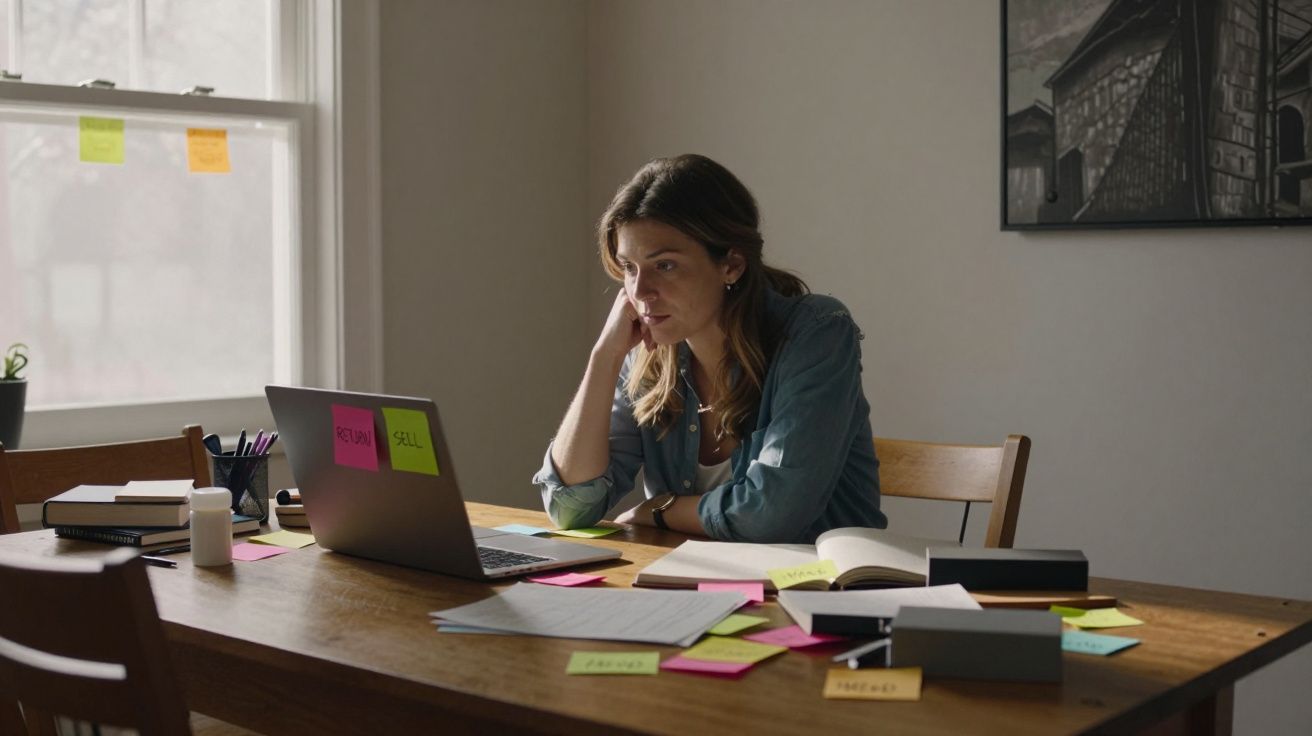
The dining table had disappeared months ago.
Somewhere under the laundry that needed folding, the post that needed answering and the Lego that apparently needed to be everywhere, there was a perfectly nice oak surface. You just couldn’t see it any more.
I arrived at my client’s house with a label maker, clear boxes, a timer… and a £4 stack of neon sticky notes from the supermarket. She eyed the notes like they were the least impressive thing in the bag.
An hour later those same flimsy squares were on every surface: “RETURN”, “SELL”, “MEND”, “ASK PARTNER”, “GOES UPSTAIRS”.
Nothing had been lifted yet, but the room already looked different, as if someone had drawn a map of the chaos. My client stood very still and said, “Oh. I can suddenly see what’s going on.”
The transformation didn’t start with a big clear-out. It started with paper the size of a teabag.
The tiny experiment that actually worked
Professional organisers use all sorts of clever systems, but the most surprising constant in their bags is a simple pad of sticky notes. Not because they’re cute or Instagrammable, but because they do something your tired, clutter-blind brain cannot: they make every decision visible.
Most homes with “too much stuff” don’t actually have a storage problem. They have an unmade decisions problem. Do I keep this? Where does it live? Does it belong to me or the kids? Should it be in this room or another one?
Sticky notes turn those vague questions into firm categories.
Instead of picking up the same object twelve times across three months, you touch it once, label the decision and walk away.
“People think they’re paying me for fancy storage,” one organiser told me. “What they’re really paying for is a way to see their things differently. Sticky notes are the cheapest vision tool we’ve got.”
Within 20 minutes of that first session, the dining table stopped being “a mess” and started being a series of clear, labelled zones. Same items, same house, different brain state.
Why a 90p square changes how your brain sees stuff
On the surface, sticky notes are just stationery. Underneath, they are mild psychology with a strip of glue.
Clutter thrives on three things: decision fatigue, vague categories and out-of-sight guilt. When you’ve asked yourself “what shall I do with this?” for the fiftieth time today, your brain quietly opts out and leaves it where it is.
A sticky note breaks that loop in three ways:
- It separates thinking from doing. You can decide “MEND” or “DONATE” today, and actually take the bag out next Saturday.
- It shrinks the decision. Writing “CHECK WITH EMMA BY FRIDAY” feels smaller than “deal with all this sentimental stuff”.
- It makes progress visible. A row of neon squares across a sideboard screams “you’ve started”, which is often enough to keep you going.
There’s also a neat brain quirk at play: once we label something, we’re more likely to act in line with that label. A bag that says “CHARITY SHOP THIS WEEKEND” sitting by the door has a very different psychological weight to an anonymous bin bag slumped in the hall.
How professional organisers actually use them
Organisers don’t just fling sticky notes around like confetti. They use them in specific, repeatable ways that anyone can borrow.
The most common moves look like this:
- Decision labels: KEEP, DONATE, SELL, BIN, RECYCLE, MEND, RETURN, UNSURE.
- Owner labels: MUM, DAD, KIDS, LANDLORD, WORK, SCHOOL.
- Location labels: KITCHEN, OFFICE, LOFT, BEDROOM, GARAGE, HALL CUPBOARD.
- Time labels: URGENT, THIS WEEK, NEXT MONTH, SEASONAL, LATER.
In a typical session, we’ll pick one surface or one category (like “papers” or “toys”) and work fast: no deep sorting yet, just rapid-fire decisions and labels. No object is allowed to sit there, silently accusing you. Everything gets a word.
“Labelling first removes the emotion,” another organiser says. “Once people see that 80 per cent of a pile is DONATE or RECYCLE, the guilt drops and momentum takes over.”
A few quiet rules keep those little squares from turning into more clutter:
- Use one colour per purpose (e.g. pink for decisions, yellow for locations, green for time).
- Write in thick, bold pen you can read from across the room.
- Don’t stack the notes neatly; let them fan out so colour blocks are obvious.
- Treat notes as temporary instructions, not permanent stickers.
A step-by-step session you can copy
Here’s a simple version of what many organisers do with clients, shrunk down to one table or worktop.
1. Set up your key labels
Grab three to five pads of sticky notes (or divide one pad into colour-coded corners with a marker). Write these headings before you start:
- KEEP – BELONGS HERE
- KEEP – BELONGS ELSEWHERE
- DONATE / GIVE AWAY
- RUBBISH / RECYCLING
- ACTION – DO SOMETHING
Stick each heading somewhere visible: the back of a chair, the edge of a shelf, the wall.
2. Do a “flying visit” over the surface
Stand at the table, sideboard or desk you’re tackling. You are not “decluttering” yet; you are only naming.
Pick items up one by one. For each one, ask: “What kind of thing is this to me right now?” Is it rubbish, a keepsake, something that belongs in another room, or something that needs an action (phone call, return, repair)?
Write the decision on a sticky note and slap it on the item.
Move on immediately. No trips to other rooms, no hunting for the perfect drawer.
You’re aiming for speed, not perfection.
3. Group by label, not by item type
Once everything has a note, step back. You’ll see clusters of colour:
- All the yellow “ACTION” items might gather near your laptop.
- The blue “DONATE” notes might form a satisfying pile near the door.
- The green “BELONGS ELSEWHERE” things might sit together ready for a house-wide shuffle later.
Only now do you start to move things. Why? Because the thinking is done. You’re executing, not deciding.
4. Turn “ACTION” into a mini to-do list
Those ACTION-labelled items are the ones that normally haunt people. The broken lamp, the form that needs signing, the book to return. Instead of letting them drift back into general clutter, line them up and add micro-notes:
- “Email school by Wednesday”
- “Book cobbler – put in car boot”
- “Order missing screw – measure tonight”
This is where the sticky notes earn their keep. You’re not staring at a pile of random objects; you’re looking at a set of very small, very clear jobs.
5. Remove the evidence
Once the table is clear and things are in their rough destinations:
- Peel off and bin the old notes so they don’t become visual noise.
- Keep only a few live notes where they matter (on the calendar, by the front door, on the toolbox).
- Put the remaining unused pads in a visible spot ready for next time.
You don’t have to do the whole house like this. You only have to do the next square metre.
Guardrails that keep sticky notes helpful (not messy)
Used badly, sticky notes become wallpaper. Used well, they’re short, sharp prompts that disappear once the job is done.
A few boundaries organisers tend to stick to:
- Notes should expire. If it’s still on your fridge in three months, it isn’t a reminder, it’s scenery.
- Only write what your tired self will understand at a glance. “CALL” is useless; “CALL GAS CO – TUES AM” is gold.
- Keep them off beautiful finishes that might mark; use a notebook or a clip instead.
- Don’t stick notes to children or pets, however tempting.
“The power isn’t in the paper,” as one professional put it. “It’s in deciding that nothing gets to sit in your house without a job and a label, even if the label only lasts ten minutes.”
What this low-tech trick says about our clutter
For many of us, clutter stops being a pile of things and starts being a feeling. Overwhelm, shame, stuckness. The genius of a £4 pad of notes is that it doesn’t try to solve any of that directly. It simply breaks the spell of vagueness.
Instead of “I’m terrible with paperwork”, you see ten envelopes labelled TAX, SCHOOL, MEMORIES, FILE, SHRED. Instead of “the hall is always a dump”, you see three bags: RETURN TO SISTER, CHARITY SHOP, RUBBISH.
Something else happens too.
As you label, you begin to notice patterns. The clothes you keep buying but never wear. The hobbies you thought you’d love but quietly avoid. The stack of unread magazines that have become more aspiration than pleasure.
Sticky notes weren’t designed as therapy tools, but they often behave like gentle mirrors. They reflect back where your energy actually goes, not where you wish it went.
Sticky-note tactics organisers swear by
Below is a quick cheat sheet of how the pros use that £4 pad, and what it does for you in real life:
| Tactic | What you do | Why it helps |
|---|---|---|
| Decision storm | Label everything on a surface before moving anything | Separates thinking from lifting; kills decision fatigue |
| Colour-coded zones | One colour per category (keep/donate/action/etc.) | Lets you “read” a room at a glance |
| Time-bound notes | Add deadlines to action items | Stops jobs lingering forever in mental limbo |
| Owner tags | Label who an item belongs to | Ends arguments and speeds up delegating |
| Exit bags | Bag items with DONATE/RETURN labels by the door | Turns intention into actual stuff leaving the house |
None of these require special training. They require only a pen, some paper and the willingness to name what’s really going on.
The small domestic thrill nobody mentions
People expect the big reveal from decluttering: the spacious hallway, the bare worktop, the before-and-after shot. The moment that surprises them most is often smaller.
It’s the instant a chaotic corner suddenly looks mapped, not messy. The moment they stand back, read their own handwriting on a dozen cheap squares and say, “I know exactly what to do next.”
A £4 pack of sticky notes won’t fold your laundry, list your stuff on Vinted or drive your donations to the charity shop. It will do something stranger and more powerful: it will give every object in your home a short, honest conversation.
And once everything has been spoken for, even briefly, it becomes much easier to let the right things go.
FAQ:
- Won’t sticky notes just add more clutter? Not if you treat them as temporary tools. Use them during a session, then peel and bin them as you complete each task. Only a handful of “live” notes should survive on doors or in your diary.
- Do I really need lots of colours? No. One colour is enough if you write clear headings (“DONATE”, “ACTION”, “MEND”). Multiple colours simply make it easier to read a room at a glance.
- What if the rest of my household ignores the labels? Start with your own areas first. When others see how quickly labelled piles turn into clear spaces, they’re more likely to engage. You can also use name labels (MUM, DAD, KIDS) to hand responsibility back.
- Isn’t a proper label maker better? Label makers are brilliant for long-term storage (boxes, shelves, files). Sticky notes excel at short-term decisions and experiments, where you expect things to move or change. Most organisers use both.
- How often should I use this method? Many people find a 20–30 minute “sticky session” once a week on one hotspot (hallway table, kitchen counter, desk) keeps clutter from rebuilding into something overwhelming.



Comments
No comments yet. Be the first to comment!
Leave a Comment