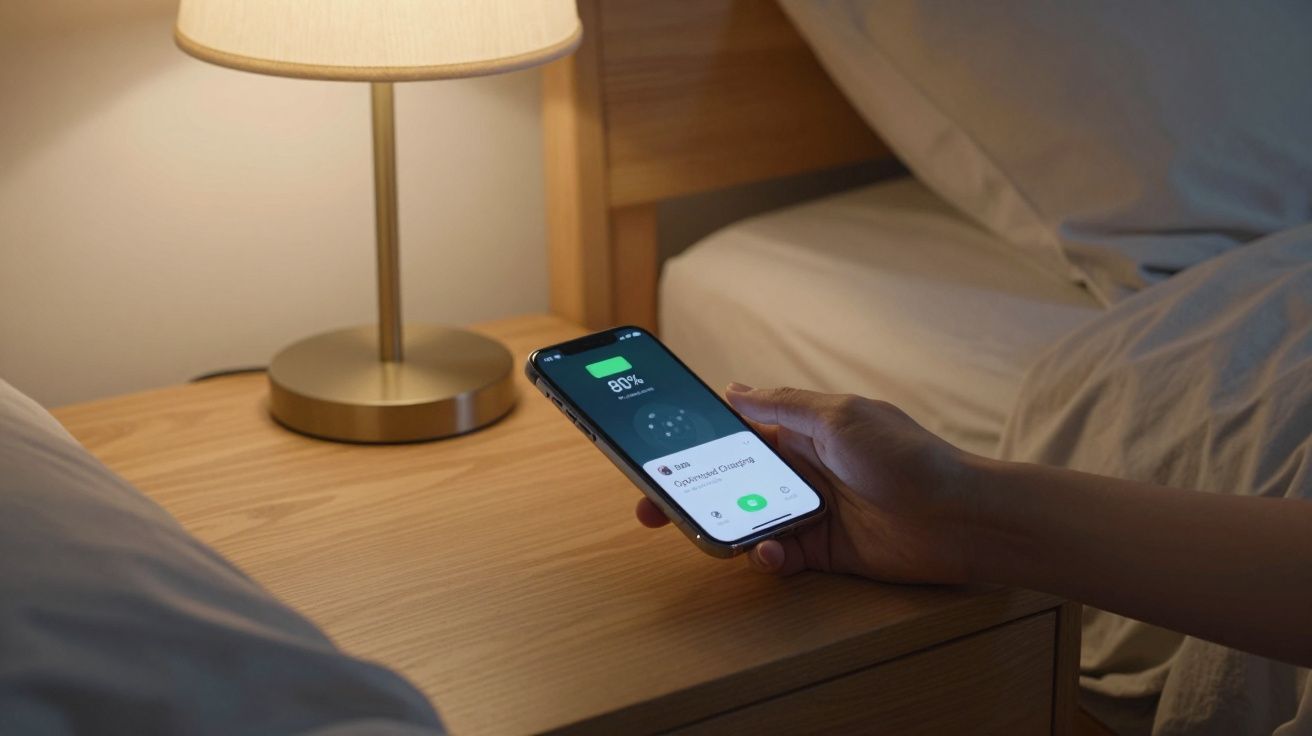
You turn off the light, put your mobile on the bedside table, and plug it in almost without thinking. By the time your alarm rings, the battery icon is a proud, reassuring 100 per cent green. It feels like you’re starting the day “full”, the way you top up a car before a long drive. Somewhere in a lab, a battery engineer is quietly wincing.
Inside that slim rectangle is chemistry that doesn’t especially like being full all the time. Kept there every night for years, it ages faster, the way a balloon left fully stretched on a shelf goes limp sooner. Most of us only notice when, 18 months in, lunchtime suddenly feels like 5 p.m. for our battery. And yet, a small, boring change could have bought you another year.
What your phone’s battery cares about (and what it doesn’t)
Lithium‑ion batteries don’t tally “number of charges” the way people imagine. They age mainly with three things: how high and low they’re pushed, how hot they get, and how long they sit at those extremes. A full cycle is roughly one move from 0 to 100 per cent, however many top‑ups it takes. Two half‑days from 40 to 90 per cent add up to about one cycle in the long run.
The detail that keeps engineers awake is voltage. At around 80 per cent, your battery is at a comfortable working tension. Push it towards 100 per cent and the voltage rises sharply. This high‑voltage state lets you squeeze out those last few minutes of screen‑on time, but it also stresses the materials inside the cell. Left there for hours overnight, day after day, it acts like a slow, invisible stretch.
Extreme lows don’t help either. Running to 0 per cent until the phone shuts itself off is the other side of the same stress. The chemistry prefers to live in the middle band. The unglamorous truth: your battery is happiest when it’s a bit boring - neither full nor empty.
The “80 per cent” rule in plain language
Ask four battery engineers for a rule of thumb and you’ll hear the same pattern: avoid the ends. In practice, that usually means something like “try to live between 20 and 80 per cent most days”. Not because 81 per cent is dangerous, but because it steers you away from the most stressful zone and the deepest drains.
Electric car makers already bake this in. Many ship with a default charge limit around 80 per cent for daily use, nudging you to reserve 100 per cent for long trips. The physics in your mobile battery is remarkably similar. By trimming the top slice, you trade a sliver of runtime today for noticeably slower wear across hundreds of cycles.
Engineers sometimes put it this way: a battery babied in the 20–80 per cent window can retain a healthier share of its capacity after 800–1,000 cycles than one hammered daily from nearly empty to completely full. You don’t see that on a spec sheet. You do feel it when a three‑year‑old phone still reaches evening without a panic‑charge.
Let your phone do the clever work
The good news is you don’t have to micromanage numbers on‑screen. Recent phones quietly offer to follow something close to the 80 per cent idea for you. Buried in settings are tools with calm names like “Optimised Battery Charging” or “Adaptive charging”. Their job is to change the when and how of the last stretch of charge.
On an iPhone, Optimised Battery Charging learns your schedule. It will rush you to roughly 80 per cent, then pause, holding there while you sleep. Near the time you usually wake up, it gently tops you to 100 per cent so you’re still “full” the moment you pick up the phone, but you’ve only been at maximum voltage for a short window, not eight straight hours.
Many Android models from Google, Samsung, OnePlus and others now do variations on the same theme. Some let you set a hard ceiling like 80 or 85 per cent; others simply delay the “last bit” if you plug in overnight. You still see 100 per cent when it matters. Behind the scenes, the battery spends more of its life in its comfort zone.
“If you’re going to plug in every night, at least let the software stop charging early,” one engineer told me. “You’re not charging harder, you’re charging smarter.”
Everyday habits that quietly add years
Beyond toggling a setting, a few small shifts compound. None require you to hover over a socket with a stopwatch.
- Avoid living at 100 per cent on heat‑heavy days. High charge plus high temperature is the worst pairing. If your phone feels hot while gaming or using navigation in the sun, unplug when it’s near full and let it cool.
- Don’t fear small top‑ups. Plugging in for 10 minutes here and there is fine. Several shallow charges are easier on the battery than repeated plunges to near‑0 followed by a full blast to 100.
- Use slower charging when you can. Fast chargers are useful in a rush but generate more heat. For overnight or desk charging, a lower‑power plug or wireless pad at modest speed is kinder.
- Avoid regular 0 per cent shutdowns. Letting a phone die occasionally won’t kill it, but making it a habit accelerates ageing. Treat 10–20 per cent as your informal “refuel” point.
- Keep cases in mind. Thick, insulating cases trap heat while charging. If your phone routinely gets very warm when plugged in, consider removing the case or changing your charging setup.
Nobody does all of this perfectly. The aim is not to turn charging into a chore, but to nudge a few big levers: less time pinned at 100 per cent, fewer deep drains, and less heat.
When 100 per cent still makes sense
There are days when the theory collides with reality. A long train journey, back‑to‑back meetings away from a plug, or travel days when your boarding pass, maps and tickets all live on your screen. On those days, use the full tank. The 80 per cent rule is a guideline for the average day, not a law for every day.
Older phones with already‑tired batteries are another case. If you’re limping to lunchtime at 60 per cent health, rigidly stopping at 80 may feel impractical. In that situation, think of the rule as a way to slow further decline rather than reverse what’s gone. A battery replacement can reset the clock far more dramatically than any setting.
And convenience matters. Some people will happily give up a chunk of potential lifespan for maximum all‑day certainty. Others, especially those keeping a handset for four or five years, prefer small habits now for fewer compromises later. The key is understanding the trade‑off, not being surprised by it.
The memo in one glance
- Try to live between 20–80 per cent on routine days; save 100 per cent for when you truly need it.
- Avoid long nights parked at 100 per cent by using Optimised/Adaptive charging or a charge limit.
- Heat is the hidden enemy: high charge plus high temperature ages batteries faster.
- Shallow, frequent top‑ups beat deep, infrequent drains for long‑term health.
- A future battery swap is normal, but these habits can delay it and keep performance steadier.
Key levers and what they change
| Focus area | What to do most days | Why it helps |
|---|---|---|
| Charge range | Aim for roughly 20–80 per cent | Keeps voltage in the battery’s comfort zone |
| Night charging | Use optimisation or limits, avoid hot spots | Cuts hours spent at 100 per cent and overheated |
| Daily use | Prefer small top‑ups, avoid 0 per cent | Reduces deep‑discharge stress and extra heat |
FAQ:
- Is it “bad” to ever charge to 100 per cent? No. Hitting 100 per cent occasionally, or on days when you need maximum runtime, is fine. The issue is parking the phone at 100 per cent and warm every single night for years.
- Do fast chargers ruin batteries? Used constantly, high‑power fast charging can add more heat and slightly faster wear. Used when you’re in a hurry, and slower charging the rest of the time, the impact is modest.
- Should I always wait until 20 per cent before plugging in? Not strictly. 20 per cent is a rough comfort marker, not a hard floor. Plug in earlier if it suits you; just try not to make regular deep drops to nearly 0 per cent.
- Does wireless charging harm the battery more than a cable? Wireless pads can run warmer, especially under thick cases. If the phone stays only mildly warm, the effect is small. If it routinely gets hot, switch to a cooler wireless pad or a cable for long charges.
- Is replacing a battery better than buying a new phone? Often yes. A professional battery replacement can restore most of the original stamina at a fraction of the cost and environmental impact of a new handset, especially if the rest of the phone still suits your needs.






Comments
No comments yet. Be the first to comment!
Leave a Comment