The smell arrived before the memory. A faint, stale echo of last night’s fried onions hanging in the hallway, clinging to the stair carpet, turning the air a little thick. You’d wiped the worktops, opened the tiny sash window as far as it would grudgingly go, even lit the “linen fresh” candle you save for guests. Yet in the morning, there it was again, hiding somewhere between the coat hooks and the ceiling.
Terrace houses are unforgiving about scent. One pan of fish and suddenly the whole place feels like a chip shop with bedrooms. Sprays flutter down in a mist of promise, masking for a moment, then settling uselessly on skirting boards. Diffusers hum, candles flicker, and the curry still owns the curtains. It can feel as if you’re losing an invisible battle.
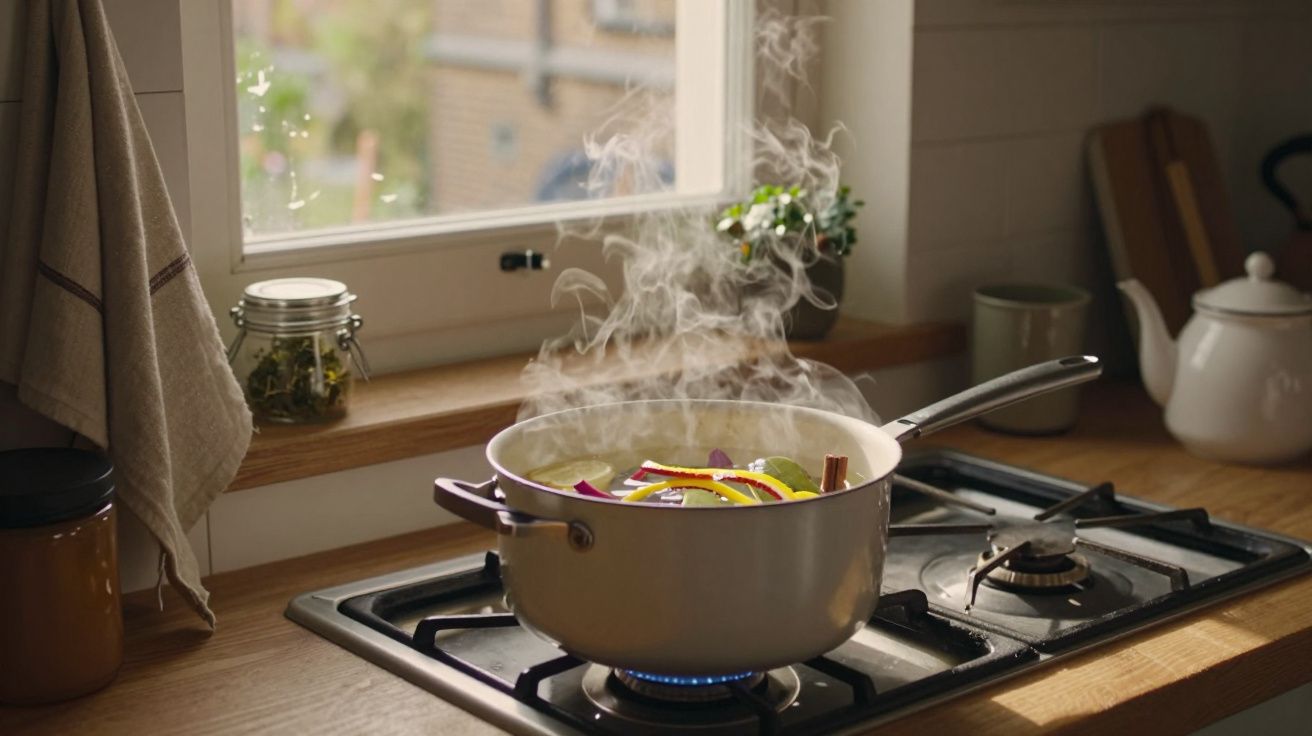
My grandmother never bought room spray. She had a battered enamel saucepan, a jam jar of bay leaves and a habit of “putting a pot on” as calmly as other people put the kettle on. No labels, no packaging – just peel, herbs, water and time. Half an hour later the house smelt not of perfume, but of nothing much, with a soft ghost of lemon and wood smoke.
She wasn’t scenting the air; she was cleaning it, gently, on the hob.
Why cooking smells cling in tiny terraces
Odour doesn’t just float; it lands. When you fry, roast or sear, hot, oily molecules hitch a lift on steam and smoke. In a small terrace kitchen, especially one that opens straight into a sitting room, there’s nowhere for them to go except into everything porous they can find: cushions, coats on the bannister, the stair carpet that’s seen better decades.
Warm, still air is their ally. Radiators under windows, double glazing that barely opens, and an extractor fan that mainly sounds busy – all of this turns your home into a low-speed odour trap. The molecules cool, stick and wait. The next time the heating clicks on or the sun hits the wall, they rise again, faint but persistent.
Sprays don’t remove those molecules; they layer over them. A floral top note, a synthetic “freshness”, and underneath, the same old garlic. It’s not a hygiene failure. It’s physics, fabric and a lack of fresh air.
A simmer pot changes the equation by making the air move and work for you.
The old-fashioned fix: a pot that cooks the air
A simmer pot is brutally simple: a pan of water kept just below a boil, with a handful of aromatic, mildly acidic ingredients tossed in. It’s not a recipe you eat; it’s a recipe the house breathes.
As the water heats, three things happen at once. Rising steam nudges odour molecules off fibres and out of corners. A light acidity in the water (from citrus peel or a splash of vinegar) helps break down some of the compounds that make smells stubborn. Meanwhile, essential oils from herbs and spices ride the same steam, not to shout over the cooking odour, but to gently redraw the background.
It feels almost too low-tech to take seriously. Yet within twenty minutes the kitchen air shifts from “after chips” to “after rain with a hint of herb garden”. You’re not hiding the smell – you’re shortening its life.
Unlike a candle, a simmer pot adds a touch of humidity, which helps odours drop out of the air faster. Unlike a spray, it uses heat and circulation, not just fragrance, to change what’s actually hanging over the hob and soaked into the tea towels.
The terrace blend: the recipe you remember half-asleep
You don’t need a Pinterest-perfect line-up of ingredients. The classic terrace-house blend uses what’s already knocking about by the sink.
Base ingredients (pick what you have):
- 1–2 litres of water in a wide, sturdy saucepan
- Peel from 1 lemon or orange (in big strips, pith and all)
- 2–3 bay leaves (dried is fine)
- 1 short sprig of rosemary or thyme, or a pinch of dried herbs
- 1 cinnamon stick or 6–8 whole cloves (optional, but powerful)
- 1–2 tablespoons of clear vinegar (white, cider or cleaning vinegar)
You are not aiming for a festive potpourri. You’re building four simple “jobs”: steam, acidity, green notes, and a warm spine from spice.
How to run the simmer pot – step by step
Fill and flavour
Fill the pan halfway with water. Add peel, herbs, spices and vinegar. No chopping, no fuss – just in it goes.Bring to a gentle simmer
Put the pan on the largest hob ring, lid off. Bring it just up to a simmer, then turn it right down so the surface barely shivers. You want steam, not a rolling boil.Crack a window, even a little
Open the nearest window or back door a finger’s width. The steam pushes the old odour out; the gap gives it somewhere to escape.Let it work for 20–40 minutes
Leave the pot on the lowest safe setting while you finish washing up or wind down. Top up with hot water from the kettle if it drops below halfway.Do a nose check from the hallway
Walk out to the front door and back. The “after dinner” line in the air should feel lower, cleaner, less clingy. If fish or frying night was particularly bold, give it another 20 minutes.Switch off, let cool, then tip away
Once you’re done, turn the hob off. When completely cool, strain the contents and pour down the sink (bonus: the drain smells fresher too).
Safety note: never leave a simmering pan unattended, and keep handles turned inwards, especially in narrow galley kitchens.
What each ingredient is really doing
| Ingredient | Job in the pot | When to lean on it |
|---|---|---|
| Citrus peel | Light acidity + clean top note | After fish, onions, frying |
| Bay & herbs | Earthy “home” smell, rounds edges | After strong spice or meat |
| Cinnamon/clove | Warm backbone, distracts nose gently | When guests are due soon |
| Vinegar | Quiet chemical workhorse, cuts heaviness | Any time air feels “stale” |
Why this beats room sprays (especially in old terraces)
A good room spray can feel satisfying for about ten minutes. Then the cloud thins and you’re left with a complicated mix: synthetic lily, last night’s korma, and the faint dust of old floorboards. A simmer pot approaches the same problem from the opposite direction.
- It moves air, not just scents it. Rising steam lifts odours off fabric and paintwork, helping them drift towards that cracked window instead of sitting stubbornly in corners.
- It breaks down, rather than piles on. Mild acidity and warmth help nudge certain smell compounds into less aggressive forms, instead of adding new ones on top.
- It respects old houses. Terraces with small rooms and low ceilings can feel overwhelmed by heavy fragrance. A simmer pot gives a background hush, not a department-store counter.
There’s also something oddly calming about treating the air as another thing you cook. No plastic bottle, no sharp “spritz” sound, no blue liquid promising miracles. Just a quiet pan and the slow sense that the room can breathe again.
Odour is a symptom, not the enemy. The simmer pot goes after the source – not your nose.
Small habits that keep the air neutral
You don’t need to run a simmer pot every night. Think of it as your “deep reset” for stubborn smells, backed up by a few quick shifts in routine.
- Start the pot ten minutes before you tackle the washing up, so it’s already working while you dry pans and hang tea towels.
- Keep one “simmer pan” you don’t use for food, to avoid any flavour crossover and make it a brainless grab.
- After particularly smoky cooking, wipe the hob and splashback with a hot, wrung-out cloth while the pot runs; it stops new residues feeding future smells.
- Once a week, give soft furnishings in the kitchen–living area a brisk shake or hoover. They’re the unsung sponges of the house.
- If you have an extractor fan, use it with the simmer pot: fan on for the cooking, off for the quiet clearing afterwards, window just open enough to let the air turn over.
None of this is about achieving a scented-home advert. It’s about returning your terrace to neutral, so the next smell you notice is the one you’ve chosen – coffee, clean sheets, or nothing at all.
Enamel pan + peel + herbs + time – in that order – is the real shortcut.
FAQ:
- Does the house end up smelling like vinegar? Used in small amounts with peel and herbs, vinegar disappears into the background. If you’re nervous, start with a teaspoon; your nose will barely notice, but the air will.
- Can I reuse the same simmer pot water the next day? It’s better not to. The mix cools, goes flat and can pick up a faint “stewed” note. Tip it away when cool and start fresh; the ingredients are cheap for a reason.
- Will this get rid of strong curry or fish smells completely? It will shorten how long they linger and soften their edges, especially in textiles, but very intense cooking may still whisper the next day. Pair the pot with a cracked window and a quick fabric refresh for best results.
- Is any saucepan suitable, or do I need something special? Any sturdy pan with a thick base works. Avoid your very best stainless steel if you use a lot of spice, as it can take on a faint tint over time – an old enamel or heavier aluminium pan is ideal.
- Can I leave a simmer pot on while I pop to the shop? No. Treat it like any other pan on the hob: stay nearby, check the water level, and turn it off if you’re leaving the house or getting absorbed in something upstairs.


Comments
No comments yet. Be the first to comment!
Leave a Comment