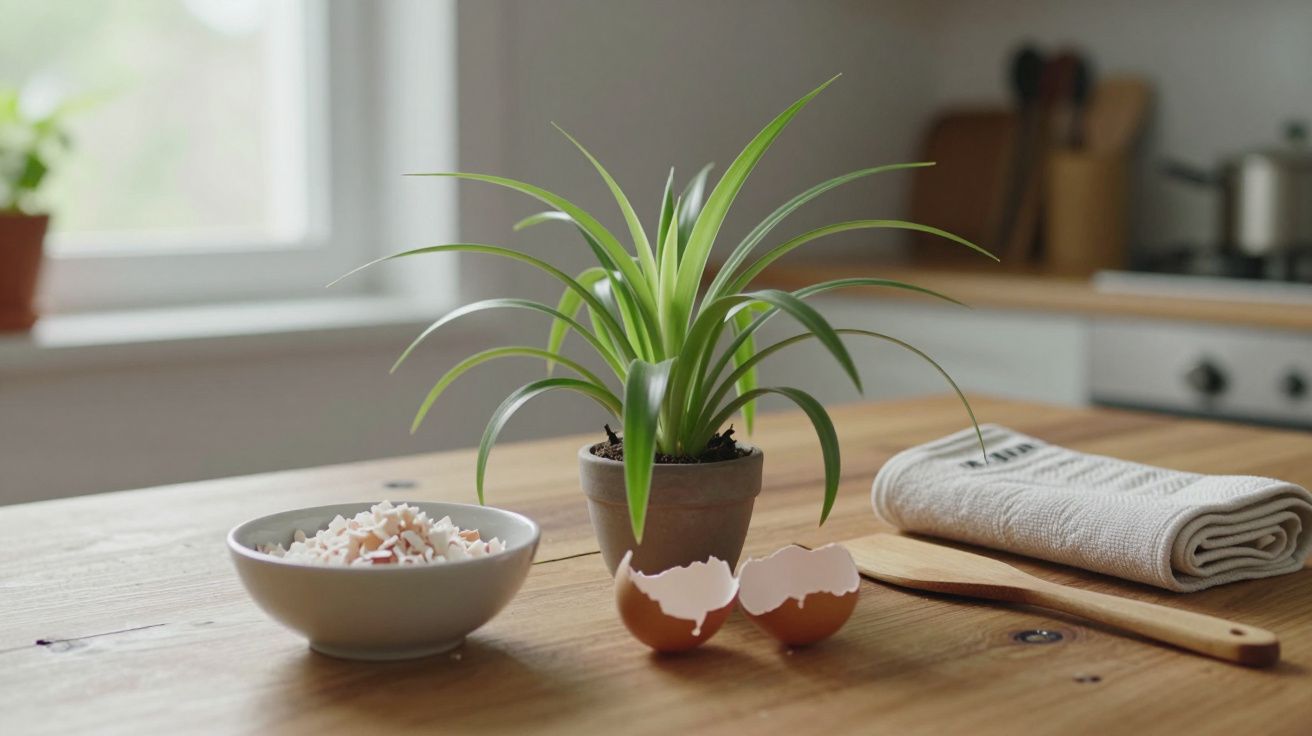
The pot has been accusing you for weeks.
Soil crusted hard on top, a ring of brown on the leaves where green used to be, that one heroic stem leaning towards the window as if it might just walk out. You water, you stop watering, you rotate it a quarter turn like a safe dial. Nothing changes. This is what “sad houseplant” really looks like: not dead, just stuck.
A friend who actually knows what they’re doing with plants comes over, glances at the drooping spider plant on your shelf, and says something completely unexpected.
“Have you got any eggshells?”
Not fancy fertiliser, not a new pot, not a shopping list. Just yesterday’s breakfast, rinsed and crushed. It sounds a bit too simple… until you understand what’s quietly going on in that soil.
What crushed eggshells really do in potting soil
On paper, eggshells are mostly calcium carbonate – about 90–95%. In real life, that means each shell is a tiny, slow‑release calcium packet wrapped in a fragile ceramic. When you crush it and mix it through potting soil, you’re adding structure and a gentle trickle of nutrients, not a dramatic chemical bomb.
Calcium is the mineral plants use to build strong new cell walls. Without enough of it, new growth can come in weak, twisted, or with brown patches at the tips and edges. You see this most clearly in fast‑growing plants and young leaves. Older leaves stay as they are; it’s the fresh ones that show the shortage first.
Most commercial potting mixes do contain some calcium, but over time – with watering, repotting, and the odd bit of neglect – that balance can drift. You end up with compacted, slightly sour soil that drains badly and doesn’t have much mineral backbone left. That’s when a gentle top‑up of calcium and texture can help.
Crushed eggshells offer both. The coarse grit helps break up heavy, tired compost, creating tiny air pockets around the roots, while the calcium very slowly dissolves into the soil solution. Not in days, but over months.
A simple picture you can hold: a peace lily living far too long in the same pot, its compost dense and sour‑smelling, new leaves emerging pale with brown tips. You repot into fresh mix but stir in a good handful of finely crushed eggshells. Over the next few months, drainage improves, new leaves arrive firmer, and that constant edge‑browning quietly fades. No magic. Just a small mineral nudge and better physical soil.
It’s worth saying plainly what eggshells don’t do. They don’t fix every nutrient deficiency on their own. They don’t instantly raise pH in the dramatic way garden lime does. And they absolutely don’t replace regular, balanced fertiliser for hungry, fast‑growing plants. They’re a background helper, not the main act.
Why sad houseplants often respond so well
When a houseplant looks miserable, it’s almost never just one thing. It’s low light plus overwatering. Old, compacted compost plus a forgotten feed. A pot with no drainage hole plus a radiator below the windowsill. The plant doesn’t have a single complaint; it has a little list.
The quiet part nobody tells you is that roots need three basic conditions to recover: air, a steady supply of water, and access to nutrients they can actually absorb. Fix those, and many “lost causes” perk up far more than you’d expect.
Crushed eggshells help in two of those three areas:
- Structure: Mixed into potting soil, they act like tiny spacers. Water can move through more freely, and fine roots can weave around them instead of sitting in a solid, airless lump.
- Calcium: As the shells slowly break down, calcium becomes available for the new growth your plant is trying to put out as it recovers.
Houseplants that often respond well to a calcium and structure boost include:
- Fast‑growing foliage plants like pothos, tradescantia and spider plants
- Thirsty bloomers like peace lilies and geraniums kept indoors
- Herbs on the windowsill (especially basil and parsley) that sulk in heavy compost
One long‑time gardener I know sums it up like this:
“Eggshells don’t bring a plant back from the dead. They stop the next bit of new growth from giving up as well.”
Often, the real rescue is the combination: repotting, fresh mix, better drainage, and a quiet scattering of shells in the background.
How to use eggshells without turning your pots into compost bins
Done badly, eggshells can be a bit grim: half‑raw, corners poking up through the compost, a faint kitchen smell if they never dry properly. Done well, they’re almost invisible – your plants benefit and nobody walking past would ever guess yesterday’s omelette is in the pot.
A simple, clean way to do it:
- Rinse the shells straight after cracking the eggs to remove any clinging white or yolk.
- Dry them fully – on a sunny windowsill, in a low oven after you’ve finished cooking, or just overnight on a plate.
- Crush them very small. You’re aiming for coarse sand or fine grit, not big shards. A rolling pin in a bag, a clean jar used as a pestle, or a quick blitz in a food processor all work.
- Mix, don’t just sprinkle. For repotting, stir roughly one small handful of crushed shell into every litre of potting mix. For an established plant, gently loosen the top 2–3 cm of soil and fold a tablespoon or two of shell into that layer.
- Water as normal, and don’t expect overnight fireworks. You’re setting the stage for the next few months of growth.
Two details matter more than they first appear:
- Fine texture: The smaller the pieces, the more surface area for microbes and mild acids in the soil to work on, and the quicker the calcium becomes available. Big flakes can take years.
- Cleanliness: Any remaining egg white or membrane is what attracts smells and pests, not the shell itself. Proper drying shrinks the membrane and makes it easier to crush cleanly.
You also don’t need mountains of the stuff. Soyons honnêtes : personne ne mange assez d’œufs pour fill every pot in the house weekly. A modest, regular trickle of clean, well‑crushed shell is plenty.
Plants that like (and don’t like) the eggshell treatment
Some houseplants are happier with a touch of extra calcium and a slightly more stable pH. Others prefer their compost on the acidic side and won’t thank you for overdoing it.
As a rule of thumb:
- Good candidates:
- Spider plants, pothos, philodendrons
- Snake plants and many easy succulents (in moderation)
- Peace lilies, ZZ plants, rubber plants
- Spider plants, pothos, philodendrons
- Use lightly or skip:
- True acid lovers like azaleas, gardenias, and some ferns
- Orchids in bark‑based mixes (they have very specific preferences)
- True acid lovers like azaleas, gardenias, and some ferns
If in doubt, start with one or two non‑fussy plants and watch how the next flush of leaves behaves over a couple of months.
A quick “eggshell rescue” plan for a struggling plant
When you’ve got a single pot that looks particularly miserable, it helps to follow a simple, repeatable routine rather than throwing random tricks at it.
You could try:
Check the basics first.
Is there a drainage hole? Is the pot sitting in water? How close is it to the window? Move it to bright, indirect light and tip away any standing water.Refresh the soil.
Slide the plant out of its pot. If the roots are circling and the compost looks dark and compacted, gently tease some of it away. Repot into fresh, good‑quality houseplant compost one size up, with a handful of fine eggshell mixed through.Trim and tidy.
Remove dead or completely brown leaves. Leave anything half‑green; it’s still feeding the plant.Start a light feeding routine.
Use a balanced liquid fertiliser at half strength every 3–4 weeks in the growing season. The eggshells provide background calcium; the fertiliser covers nitrogen, potassium, and the rest.Watch the new growth, not the old.
Eggshells won’t repaint damaged leaves. What you’re looking for is whether the next round of leaves emerges stronger, less blotchy, and less prone to crispy edges.
Think of the shells as scaffolding. They don’t rebuild the house for you, but they stop the next bit of brickwork from crumbling while the plant does the hard work inside.
What eggshells help with – and what they don’t
A lot of online tips blur into myth territory. Separating the real benefits from the wishful thinking makes it easier to decide when to bother saving shells and when to reach for something else.
| What eggshells can help with | What they won’t fix | When to try something else |
|---|---|---|
| Gradual calcium top‑up for new growth | Severe yellowing from lack of nitrogen | Use a balanced liquid fertiliser |
| Slightly improving drainage and soil structure | Root rot from chronic overwatering | Repot into fresh mix and adjust watering |
| Stabilising pH in tired, sour compost (gently) | Sudden leaf drop from cold drafts or low light | Move the plant and adjust its position |
If your plant is collapsing overnight, or if the soil smells swampy and sour, the shells are not the first tool to reach for. They shine in the slow, steady recovery phase, not in emergency surgery.
Rethinking “waste” when you water the plants
There’s something quietly satisfying about tipping a jar of clean, crushed eggshell into a bowl of potting mix and knowing that nothing in that handful came from a shop. Breakfast became scaffolding. Rubbish became structure.
Once you start doing it, you notice the pattern everywhere: coffee grounds going into outdoor beds, banana skins feeding a compost heap, teabags (without the plastic) returning to the soil they came from. Houseplants become less of a décor item and more of a small, circulating system you’re part of.
The point isn’t to hoard every scrap from the kitchen. It’s to see that some of the gentlest, most effective plant fixes are the least glamorous. Not a bottle with a glossy label – just a habit repeated quietly over time.
Your next sad houseplant might not need a replacement. It might just need a better home under the soil line, a more breathable mix, and the invisible backbone of a few breakfasts past.
FAQ:
- Do eggshells work faster if I add them as a tea or soak them in water?
Not dramatically. Soaking shells can release a tiny amount of calcium into the water, but it’s usually very weak. Mixing finely crushed shells directly into the compost gives a steadier, long‑term benefit.- Will eggshells attract pests or make my soil smell?
Clean, well‑dried shells do not usually smell or attract pests. Any odour comes from leftover egg white or membrane. Rinse and dry thoroughly before crushing, and mix into the soil rather than leaving large pieces on the surface.- Can I use eggshells instead of fertiliser?
No. Eggshells mainly supply calcium and a little structure. Most houseplants still need a balanced fertiliser for nitrogen, phosphorus, potassium and trace elements, especially during active growth.- Is it safe to use eggshells with every watering?
There’s no need. Eggshells break down slowly, so adding small amounts occasionally – for example when repotting or refreshing the top layer of compost a couple of times a year – is enough for most plants.- Are baked eggshells better than air‑dried ones?
Baking shells at a low temperature can help them dry faster and makes them easier to crush very fine, but it doesn’t magically change the nutrients. The key is that they’re dry, clean, and broken into small pieces, whichever method you use.






Comments
No comments yet. Be the first to comment!
Leave a Comment